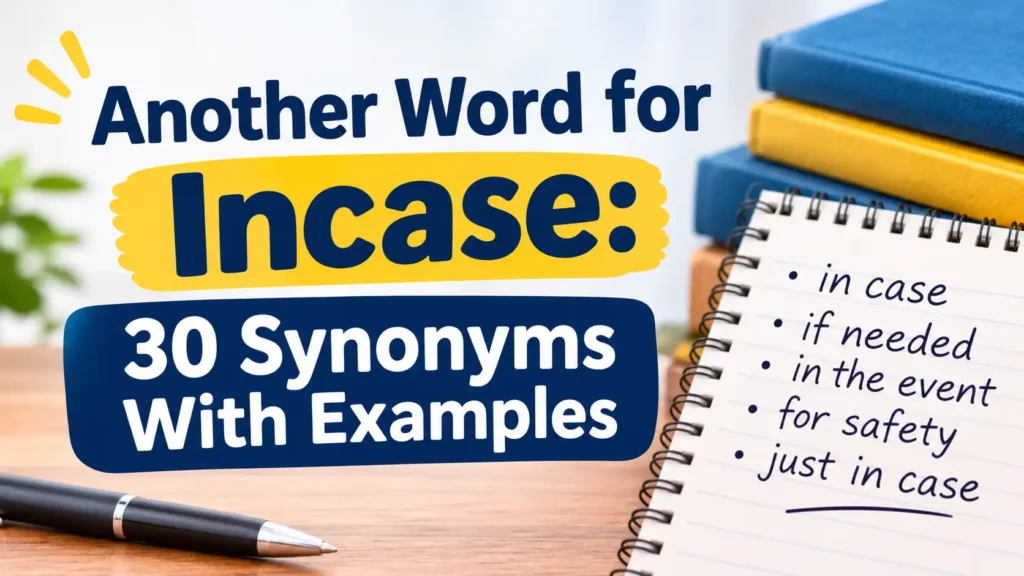
The closest alternatives to incase are in case, just in case, in the event of, and as a precaution. However, the correct spelling depends on what you mean.
In standard English, there are two words when you mean preparing for something that might happen. The one-word spelling is nonstandard for this meaning. However, incase has also appeared as a variant of the verb encase, meaning to enclose or cover something.
Quick list: In case, just in case, in the event that, in the event of, if necessary, if needed, as a precaution, to be safe, in preparation for, and as a safeguard.
This guide examines 30 alternatives with meanings, IPA, usage notes, examples, and context. It also explains the spelling difference between in case and encase.
At a Glance: Incase Synonyms and Related Alternatives
| Alternative | Part of Speech | Meaning | Register / Tone | Ideal Context |
| In case | Conjunction | If something might happen | Neutral | Everyday writing |
| Just in case | Adverbial phrase | As a precaution | Informal | Daily conversation |
| In the event that | Conjunction | If something happens | Formal | Official writing |
| In the event of | Preposition | If something occurs | Formal | Notices and rules |
| As a precaution | Adverbial phrase | To prevent possible trouble | Neutral | Safety and planning |
| To be safe | Adverbial phrase | To avoid possible risk | Informal | Everyday speech |
| If necessary | Adverbial phrase | If something becomes needed | Neutral | Instructions |
| If needed | Adverbial phrase | If something is required | Neutral | General writing |
| As a safeguard | Noun phrase | As a way to prevent harm | Formal | Protection |
| Encase | Verb | To cover or surround fully | Neutral | Physical objects |
Note: These alternatives do not all have the same meaning. Some replace the precaution sense of in case, while others relate to the verb encase.
Which Word Should You Use?
| If you want to… | Use | Why |
| Prepare for something that might happen | In case | It shows a possible future event |
| Make a quick precaution | Just in case | It sounds natural in daily speech |
| Write in a formal tone | In the event that | It suits formal statements |
| Mention an emergency | In the event of | It works before a noun |
| Avoid possible trouble | As a precaution | It highlights careful planning |
| Keep something ready | As a backup | It shows readiness for a possible need |
| Explain a possible need | If needed | It keeps the sentence short |
| Cover something fully | Encase | It expresses physical covering |
Exploring the Multiple Meanings of “Incase”
The spelling and context matter when understanding this word.
1. Preparing for a Possible Event
Meaning: In case means taking action because something might happen later.
Explanation: You prepare before knowing what will happen. This meaning often appears in daily speech and writing.
Example: I packed an extra shirt in case the weather changed.
2. Taking a Precaution
Meaning: In case can explain why someone takes an extra safety step.
Explanation: The action helps someone stay ready. It also shows care about a possible problem.
Example: She saved the phone number in case she needed help.
3. Just in Case
Meaning: Just in case means doing something as an extra precaution.
Explanation: People often use this phrase in casual talks. It also works at the end of a sentence.
Example: I brought some extra cash just in case.
4. In Case of an Event
Meaning: In case of means if a particular event happens.
Explanation: This phrase comes before a noun or noun phrase. It often appears in signs, rules, and safety notices.
Example: In case of rain, the school event will move indoors.
5. Enclosing or Covering Something
Meaning: Incase is a historical or less common variant of encase.
Explanation: It means placing something inside a case or covering it fully. However, modern standard English favors encasement.
Example: Workers encase the fragile item in a protective shell.
Analyzing 30 Incase Alternatives in Detail
Some alternatives directly replace the precaution meaning of in case. Others fit particular contexts or relate to the verb encase.
Core Alternatives for Possible Events
1. In Case
IPA: US and UK /ɪn ˈkeɪs/
Definition: This phrase means preparing for something that might happen. It also introduces a possible future event.
- Usage: This is the correct standard spelling for the main keyword. Moreover, it fits everyday speech and writing.
- Example: Take your jacket in case the evening gets cold.
2. Just in Case
IPA: US and UK /dʒʌst ɪn ˈkeɪs/
Definition: This phrase means doing something to stay ready. It also shows extra care about a possible event.
- Usage: It sounds casual and friendly. Moreover, people often use it when taking small precautions.
- Example: I saved an extra copy just in case.
3. In the Event That
IPA: US and UK /ɪn ði ɪˈvɛnt ðæt/
Definition: This phrase means if something happens. It also introduces a possible future condition.
- Usage: It sounds more formal than in case. However, it works well in rules and official writing.
- Example: Call the office in the event that your plans change.
4. In the Event Of
IPA: US and UK /ɪn ði ɪˈvɛnt əv/
Definition: This phrase means if a certain event happens. It also introduces a possible problem or change.
- Usage: Use it before a noun. For example, it suits signs and formal notices.
- Example: In the event of rain, please use the main entrance.
5. If Needed
IPA: US and UK /ɪf ˈniːdɪd/
Definition: This phrase means if something becomes necessary. It also leaves room for a possible need.
- Usage: It is a short and clear choice. Moreover, it fits instructions and daily messages.
- Example: Bring your school ID if needed.
6. If Necessary
IPA: US and UK /ɪf ˈnɛsəˌsɛri/
Definition: This phrase means if a certain action becomes necessary. It also suggests that action may not be required.
- Usage: It sounds more formal than if needed. However, both phrases express a similar idea.
- Example: We can change the meeting time if necessary.
Precaution and Safety Alternatives
7. As a Precaution
IPA: US and UK /æz ə prɪˈkɔːʃən/
Definition: This phrase means doing something to avoid possible trouble. It also shows careful planning.
- Usage: It focuses on the reason behind an action. Moreover, it fits safety and health contexts.
- Example: She carried an extra water bottle as a precaution.
8. To Be Safe
IPA: US and UK /tə bi seɪf/
Definition: This phrase means acting to avoid possible trouble. It also shows a wish to stay secure.
- Usage: It sounds natural in everyday English. For example, people use it when making extra checks.
- Example: To be safe, we left home twenty minutes early.
9. As a Safeguard
IPA: US and UK /æz ə ˈseɪfˌɡɑːrd/
Definition: This phrase means acting to prevent possible harm. It also suggests extra protection.
- Usage: It sounds more formal than to be safe. However, it fits plans and safety rules.
- Example: The school kept extra records as a safeguard.
10. As a Backup
IPA: US and UK /æz ə ˈbækˌʌp/
Definition: This phrase means keeping something ready for future use. It also offers another choice if needed.
- Usage: It is a related alternative, not an exact synonym. Moreover, it works well for plans and supplies.
- Example: I packed another charger as a backup.
11. In Preparation For
IPA: US and UK /ɪn ˌprɛpəˈreɪʃən fɔːr/
Definition: This phrase means getting ready for something ahead. It also points to a planned future event.
- Usage: It focuses on readiness rather than a possible condition. Still, it fits many precaution-based contexts.
- Example: We bought extra food in preparation for the storm.
12. In Anticipation Of
IPA: US and UK /ɪn ænˌtɪsɪˈpeɪʃən əv/
Definition: This phrase means doing something because an event is expected. It also shows that someone thinks ahead.
- Usage: It is more formal than in case. Moreover, it can refer to expected events.
- Example: The team packed extra supplies in anticipation of delays.
Possibility and Condition-Based Alternatives
13. Assuming
IPA: US and UK /əˈsuːmɪŋ/
Definition: This word means accepting something as possibly true. It also introduces a condition for an idea.
- Usage: It is related to in case, but it does not always express precaution. However, it suits conditional statements.
- Example: Assuming the road stays clear, we will arrive early.
14. Provided That
IPA: US and UK /prəˈvaɪdɪd ðæt/
Definition: This phrase means only if a certain condition is met. It also sets a clear requirement.
- Usage: It is not an exact synonym of in case. Instead, it introduces a condition that must hold.
- Example: You can join the trip provided that you have permission.
15. On the Off Chance
IPA: US and UK /ɑːn ði ɔːf tʃæns/
Definition: This phrase means because something might happen, though it seems unlikely. It also suggests a small chance.
- Usage: It sounds informal and conversational. Moreover, it suits uncertain events.
- Example: I called her on the off chance she was home.
16. For Fear That
IPA: US and UK /fɔːr fɪr ðæt/
Definition: This phrase means because someone wants to avoid an unwanted event. It also shows worry about a possible outcome.
- Usage: It often gives a reason for cautious action. However, it carries a stronger sense of worry.
- Example: He left early for fear that he might miss the train.
17. Lest
IPA: US and UK /lɛst/
Definition: This word means to avoid something unwanted. It also introduces a possible bad result.
- Usage: It sounds formal or literary. Still, it can replace in case in certain sentences.
- Example: She spoke quietly lest she wake the baby.
18. Should
IPA: US and UK /ʃʊd/
Definition: This word can introduce a possible future event. It also makes a condition sound formal.
- Usage: It works in formal conditional sentences. However, it is not a direct replacement in every case.
- Example: Should you need help, please contact the front desk.
Readiness and Need-Based Alternatives
19. If Required
IPA: US and UK /ɪf rɪˈkwaɪərd/
Definition: This phrase means if something must be done. It also leaves room for a future need.
- Usage: It suits formal instructions and written notices. Moreover, it often appears in work settings.
- Example: Please provide extra details if required.
20. If the Need Arises
IPA: US and UK /ɪf ðə niːd əˈraɪzɪz/
Definition: This phrase means if a need appears later. It also points to a possible future action.
- Usage: It sounds polite and somewhat formal. However, it is longer than if needed.
- Example: We will arrange another meeting if the need arises.
21. Should the Need Arise
IPA: US and UK /ʃʊd ðə niːd əˈraɪz/
Definition: This phrase means if a need occurs. It also gives a formal sense of readiness.
- Usage: It suits business letters and official messages. Moreover, it sounds more polished than if needed.
- Example: Please contact our team should the need arise.
22. If Anything Happens
IPA: US and UK /ɪf ˈɛniˌθɪŋ ˈhæpənz/
Definition: This phrase means if an unexpected event takes place. It also refers to an uncertain future.
- Usage: It sounds natural in everyday speech. Still, it is broader than the phrase in case.
- Example: Call me if anything happens during the trip.
23. In Case Anything Happens
IPA: US and UK /ɪn ˈkeɪs ˈɛniˌθɪŋ ˈhæpənz/
Definition: This phrase means preparing for any possible event. It also shows concern about an uncertain outcome.
- Usage: It keeps the main meaning of in case. Moreover, it suits casual conversations.
- Example: Keep my number with you in case anything happens.
24. Allowing For
IPA: US and UK /əˈlaʊɪŋ fɔːr/
Definition: This phrase means making room for a possible change. It also shows that someone has thought ahead.
- Usage: It is a related planning phrase, not an exact synonym. However, it works when planning for uncertainty.
- Example: We booked an extra hour allowing for traffic delays.
Alternatives Related to Enclosing and Covering
The following words relate to the less common verb sense of incase. Modern standard spelling favors encase.
25. Encase
IPA: US /ɪnˈkeɪs/ · UK /ɪnˈkeɪs/
Definition: This verb means to cover something fully or place it inside a case. It also suggests a protective outer layer.
- Usage: This is the standard modern form. Moreover, it is the closest word to the rare verb in case.
- Example: Workers encase the wires in a strong outer cover.
26. Enclose
IPA: US and UK /ɪnˈkloʊz/
Definition: This verb means to put something inside or surround it. It also refers to closing off an area.
- Usage: It is a close alternative when something goes inside a space. However, it does not always mean full covering.
- Example: Please enclose the photos in a sealed envelope.
27. Surround
IPA: US and UK /səˈraʊnd/
Definition: This verb means to place things around something. It also refers to being on every side.
- Usage: It relates to encase when an object has things around it. Still, it does not always mean complete covering.
- Example: Tall trees surround the small garden.
28. Envelop
IPA: US and UK /ɪnˈvɛləp/
Definition: This verb means to cover or wrap something fully. It also suggests being surrounded by something.
- Usage: It can sound more literary than encase. Moreover, it often refers to light, smoke, or other surroundings.
- Example: A thick cloud seemed to envelop the entire town.
29. Cover
IPA: US and UK /ˈkʌvər/
Definition: This verb means to place something over another thing. It also means hiding or protecting a surface.
- Usage: It is a simple alternative to encase in some contexts. However, cover does not always mean enclosing every side.
- Example: Cover the box with a clean sheet of paper.
30. Sheathe
IPA: US and UK /ʃiːð/
Definition: This verb means to put something inside a protective covering. It also refers to fitting a cover around an object.
- Usage: It is a more specific alternative to encase. For example, it suits wires and other covered objects.
- Example: The builder used a tube to sheathe the cables.
In Case vs. If vs. Encase
These three forms may look or sound similar. However, they have different meanings and roles.
| Word | Meaning | Example |
| In case | Prepare for a possible event | Take an umbrella in case it rains |
| If | A condition that may or may not happen | Take an umbrella if it rains |
| Encase | Cover or surround something fully | Encase the item in plastic |
The key difference
Use in case when you prepare before knowing if something will happen. Use when an action depends on a condition.
For example, taking an umbrella in case it rains means you bring it beforehand. Taking an umbrella if it rains means you take it only when rain occurs.
Meanwhile, encase is a verb about covering something. It has no connection to the precaution meaning of in case.
Incase and Opposite/Paired Word Pairs
The phrase in case has no direct opposite. However, several words and phrases offer useful contrasts.
| Word | Paired Word | Note |
| In case | If | Preparation versus a condition |
| Precaution | Risk | Care against possible harm |
| Protection | Exposure | Safety versus possible harm |
| Backup | Main option | Extra choice versus first choice |
| Prepare | Neglect | Getting ready versus failing to plan |
| Encase | Uncover | Covering versus removing a cover |
| Enclose | Open | Closing something in versus making it accessible |
| Cover | Uncover | Placing something over versus removing it |
These pairs help explain the different meanings of the keyword. However, they are not all direct antonyms. Their meanings depend on the sentence.
Common Word Partners of “Incase”
The phrase in case often appears with words about possible events, needs, and precautions.
| Pattern | Common Partners | Example |
| In case + clause | It rains, she calls, we need help | Take a coat in case it rains |
| In case of + noun | Emergency, fire, delay, illness | In case of fire, leave the building |
| Just in case | Anything happens, you need it | I saved the file just in case |
| In case + someone forgets | Anyone forgets, you forget | I sent a reminder in case you forget |
| Keep something in case | Cash, food, supplies | Keep some cash in case you need it |
| Bring something in case | Rain, delays, cold weather | Bring a jacket in case it gets cold |
| Save something in case | Questions, problems, future needs | Save the receipt in case you return it |
Idiomatic Phrases Featuring “Incase”
There are few true idioms featuring incase. However, several established expressions with in case have useful meanings.
1. Just in Case
- Meaning: This phrase means doing something as an extra precaution.
- Example: I brought an extra pen just in case.
2. In Case of Emergency
- Meaning: This expression refers to what people should do during an emergency.
- Example: Keep the emergency contact number nearby in case of emergency.
3. In Case of Doubt
- Meaning: This expression means when someone feels unsure about something.
- Example: In case of doubt, ask your teacher for help.
4. In Case of Need
- Meaning: This expression refers to a time when help or support becomes necessary.
- Example: Keep these contact details in case of need.
Word Formation of “Incase”
Etymology and Structure
The phrase in case contains two separate words:
- In: A preposition that can show position or relation.
- Case: A noun that can refer to a situation or event.
Together, they form a phrase about preparing for a possible event.
The verb in case has a different history. Etymonline records it as a variant of encase. The standard verb combines the prefix en- with case.
Date and History
Etymonline traces encase to the 1630s. Its original sense involved putting something inside a case.
The spelling case also appears in older English texts. However, modern writers generally prefer encases for the verb.
There is no need to assign the phrase in case the same history as the verb in case.
Word Class Variations
| Word Form | Part of Speech | Meaning |
| In case | Conjunction / adverbial phrase | For a possible event |
| In case of | Prepositional phrase | If an event happens |
| Just in case | Adverbial phrase | As an extra precaution |
| Encase | Verb | Cover or surround fully |
| Encases | Verb | Covers or surrounds |
| Encased | Past tense / adjective | Covered or surrounded |
| Encasement | Noun | The act or result of enclosing |
| Enclosing | Verb form | Putting something inside |
Common Word-Choice Mistakes
Here are seven common mistakes involving incase and its related alternatives.
1. Wrong: I packed food in case I got hungry.
Correct: I packed food in case I got hungry.
2. Wrong: Call me in case you need help, meaning call only if help becomes necessary.
Better: Call me if you need help.
3. Wrong: In case you forget, save the number.
Correct: In case you forget, save the number.
4. Wrong: Incase the box with plastic.
Correct: Encase the box in plastic.
5. Wrong: I brought an umbrella in case it rains.
Correct: I brought an umbrella in case it rains.
6. Wrong: In case of an emergency, call this number.
Correct: In case of emergency, call this number.
7. Wrong: She carried extra food for precaution.
Better: She carried extra food as a precaution.
Frequently Asked Questions
1. What Is the Closest Synonym for Incase?
The closest alternative is in case, written as two words. It expresses preparation for a possible event.
2. Is it One Word or Two?
For the precautionary meaning, write in the case of two words. The one-word spelling is nonstandard in this context.
3. What Is a More Formal Way to Say In Case?
Use in the event that or in the event of. Both suit formal writing and notices.
4. What Is Another Word for Just in Case?
You can say as a precaution, to be safe, or as a safeguard. However, each phrase has a slightly different tone.
5. Can I Use If Instead of In Case?
Sometimes, but the meanings differ. In case suggests preparation, while if introduces a condition.
6. What Is the Difference Between In Case and In Case Of?
In case often introduces a full clause. In case of comes before a noun or noun phrase.
7. Is Encase the Same as Incase?
They have the same basic meaning when incase appears as a verb. However, encase is the standard modern spelling.
8. What Is the Opposite of In Case?
There is no direct opposite of in case. Depending on context, words like neglect or risk may express a contrast.
9. What Is a Short Alternative to In Case?
If needed and if necessary are useful short choices. However, they do not fit every sentence.
10. Can Incase Mean Cover or Surround?
Yes, older English sources record incase as a variant of encase. However, modern writing favors encase.
Conclusion
The closest alternatives to incase include in case, just in case, in the event that, and as a precaution. For the related verb meaning, encase, enclose, and surround offer useful choices.
However, context matters when choosing the right word. In case expresses preparation for a possible event, while encase means covering something fully.For clear and correct writing, use in case for precautionary situations. Choose encase when you mean to cover or surround an object.

Sikandar Hayat is the author of PublivoHub.com, a platform dedicated to synonyms, alternative words, and vocabulary improvement. He aims to help readers find the right words and express their ideas more clearly and effectively. Through simple explanations and useful word alternatives, Sikandar makes it easier for students, writers, bloggers, and everyday readers to improve their writing and expand their vocabulary.