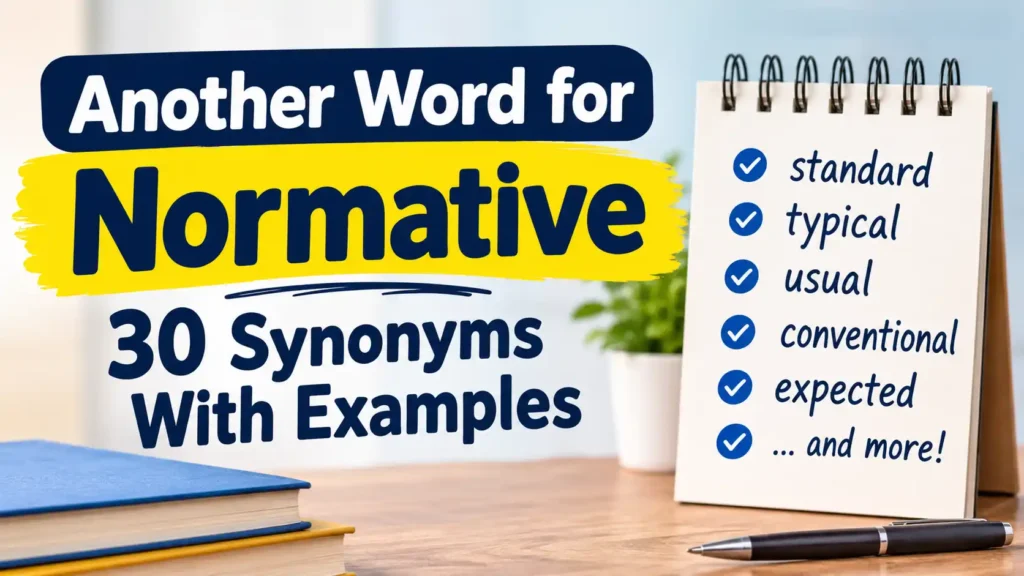
Another word for normative is prescriptive, rule-based, standard-setting, or regulatory. These words relate to rules, standards, values, and ideas about how people should act.
However, the best choice depends on context. In ethics, normative often means concerned with what people ought to do. And in grammar, it can refer to rules about correct language. In social studies, it may concern accepted customs and standards.
Quick list: Prescriptive, regulatory, rule-based, standard-setting, directive, obligatory, mandatory, evaluative, ethical, and conventional.
This guide explores 30 alternatives with meanings, IPA, usage notes, and examples. It also explains common word pairs, expressions, and related forms.
At a Glance: Normative Synonyms and Related Alternatives
| Alternative | Part of Speech | Meaning | Register / Tone | Ideal Context |
| Prescriptive | Adjective | Setting rules about what people should do | Formal | Grammar, ethics |
| Regulatory | Adjective | Relating to rules and control | Formal | Law, policy |
| Rule-based | Adjective | Following set rules | Neutral | Systems, conduct |
| Standard-setting | Adjective | Creating rules or standards | Formal | Education, policy |
| Directive | Adjective | Giving instructions or guidance | Formal | Policies, conduct |
| Obligatory | Adjective | Required by a rule or duty | Formal | Ethics, duties |
| Mandatory | Adjective | Required by authority | Formal | Law, policy |
| Evaluative | Adjective | Making judgments about value or quality | Academic | Ethics, philosophy |
| Ethical | Adjective | Relating to moral rules | Formal | Moral philosophy |
| Conventional | Adjective | Following common customs or beliefs | Neutral | Society, culture |
Which Word Should You Use?
| If you want to… | Use | Why |
| Explain what people should do | Prescriptive | It sets rules for conduct. |
| Discuss rules made by an authority | Regulatory | It relates to control through rules. |
| Explain a system that follows rules | Rule-based | It highlights the role of set rules. |
| Describe the creation of standards | Standard-setting | It focuses on making standards. |
| Give clear instructions | Directive | It points toward a required action. |
| Explain a moral duty | Ethical | It relates to right and wrong. |
| Describe something required by law | Mandatory | It shows that a rule must be followed. |
| Discuss judgments about what is good | Evaluative | It focuses on value and judgment. |
Exploring the Multiple Meanings of “Normative”
The word normative has several related meanings. Its exact sense depends on the subject and sentence.
1. Setting Rules or Standards
- Meaning: This sense refers to rules that guide how people should act.
- Explanation: It focuses on standards that guide choices. For example, a school may set rules for student conduct.
- Example: The school follows a normative code for student behavior.
2. Expressing What Ought to Happen
- Meaning: This sense deals with what people should do or believe.
- Explanation: It often appears in ethics and philosophy. It also differs from claims that simply report facts.
- Example: Her argument raises a normative question about fairness.
3. Making Moral or Value Judgments
- Meaning: This sense concerns judgments about right, wrong, good, or bad.
- Explanation: It looks beyond facts and asks what people ought to value. Ethical debates often use this sense.
- Example: The debate raised normative concerns about equal treatment.
4. Relating to Accepted Social Standards
- Meaning: This sense concerns shared rules and common ideas within society.
- Explanation: It looks at what a group expects from its members. However, accepted customs are not always morally right.
- Example: The study examined normative views about family life.
5. Setting Standards for Correct Language
- Meaning: This sense concerns rules about correct speech, writing, or grammar.
- Explanation: It focuses on language standards and accepted forms. It also appears in discussions of formal grammar.
- Example: The teacher explained normative rules for formal writing.
Sources: Cambridge Dictionary, Collins Dictionary, Oxford Learner’s Dictionaries, and the National Institute of Environmental Health Sciences.
English meaning – Cambridge Dictionary+3
Analyzing 30 Normative Alternatives in Detail
Some words below are close synonyms. Others are related choices that fit specific contexts.
Core Synonyms
1. Prescriptive
IPA: US /prɪˈskrɪptɪv/ · UK /prɪˈskrɪptɪv/
Definition: Prescriptive means setting rules about what people should do. It also gives guidance about correct conduct.
- Usage: This is the closest general alternative to normative. However, it often stresses rules and instructions.
- Example: The guide takes a prescriptive approach to formal writing.
2. Regulatory
IPA: US /ˈrɛɡjəˌlətɔːri/ · UK /ˈrɛɡjələtəri/
Definition: Regulatory means relating to rules and control. It also concerns the bodies or systems that enforce standards.
- Usage: This word suits laws, policies, and official controls. However, it focuses more on rule enforcement.
- Example: The agency introduced regulatory changes last year.
3. Rule-Based
IPA: US and UK /ˈruːl beɪst/
Definition: Rule-based means built around a set of rules. It also shows that rules guide decisions or actions.
- Usage: This is a clear choice for systems and methods. However, it does not always express moral duties.
- Example: The school follows a rule-based approach to student conduct.
4. Standard-Setting
IPA: US and UK /ˈstændərd ˌsɛtɪŋ/
Definition: Standard-setting means creating rules or levels for others to follow. It also points to the act of defining accepted standards.
- Usage: This fits policy, education, and professional fields. For example, it highlights the creation of shared rules.
- Example: The board plays a standard-setting role in education.
5. Norm-Guided
IPA: US and UK /ˈnɔːrm ˌɡaɪdɪd/
Definition: Norm-guided means shaped by shared rules or standards. It also shows that norms influence choices.
- Usage: This is a close contextual alternative in social studies. However, it stresses guidance rather than rule-making.
- Example: Their decisions follow norm-guided social practices.
Rules, Duties, and Instructions
6. Directive
IPA: US /dɪˈrɛktɪv/ · UK /daɪˈrɛktɪv/
Definition: Directive means giving instructions or clear guidance. It also points toward actions people should take.
- Usage: This fits rules and official guidance. However, it does not always carry a moral meaning.
- Example: The manager issued a directive about workplace conduct.
7. Obligatory
IPA: US and UK /əˈblɪɡətɔːri/
Definition: Obligatory means required by a duty or rule. It also suggests that someone must meet an obligation.
- Usage: Use it for duties and moral requirements. However, it is stronger than normative in some contexts.
- Example: Attendance at the safety meeting is obligatory.
8. Mandatory
IPA: US /ˈmændəˌtɔːri/ · UK /ˈmændətəri/
Definition: Mandatory means required by an official rule. It also shows that people have no choice about following it.
- Usage: This suits laws and formal policies. However, it does not cover every meaning of normative.
- Example: The school made attendance mandatory for all students.
9. Binding
IPA: US and UK /ˈbaɪndɪŋ/
Definition: Binding means having the force of a rule or duty. It also suggests that people must follow an agreement.
- Usage: This works for laws and formal duties. However, it stresses force rather than moral judgment.
- Example: The agreement sets binding rules for both groups.
10. Controlling
IPA: US and UK /kənˈtroʊlɪŋ/
Definition: Controlling means having power over actions or choices. It also suggests that rules limit what people can do.
- Usage: This is a related alternative when norms guide conduct. However, it can carry a negative tone.
- Example: The policy gives the board a controlling role.
Moral and Value-Based Alternatives
11. Ethical
IPA: US and UK /ˈɛθɪkəl/
Definition: Ethical means relating to ideas about right and wrong. It also concerns the rules people follow to act fairly.
- Usage: This fits normative discussions about moral duties. However, not every normative rule concerns ethics.
- Example: The committee raised ethical questions about the new policy.
12. Moral
IPA: US and UK /ˈmɔːrəl/
Definition: Moral means relating to right and wrong. It also concerns values that guide human actions.
- Usage: This is useful in discussions of moral norms. However, normative can cover non-moral standards too.
- Example: The debate focused on moral duties toward others.
13. Evaluative
IPA: US and UK /ɪˈvæljuˌeɪtɪv/
Definition: Evaluative means making judgments about worth or quality. It also shows if something meets a set of values.
- Usage: This fits philosophical and academic writing. In fact, it highlights judgment rather than rule-making.
- Example: The report takes an evaluative view of public policy.
14. Value-Laden
IPA: US and UK /ˈvæljuː ˌleɪdən/
Definition: Value-laden means shaped by beliefs or values. It also suggests that a statement is not fully neutral.
- Usage: This is related to normative claims. However, a value-laden statement does not always give a rule.
- Example: The article makes several value-laden claims about education.
15. Principled
IPA: US and UK /ˈprɪnsəpəld/
Definition: Principled means guided by firm beliefs or moral rules. It also suggests a clear sense of right and wrong.
- Usage: This suits ethical conduct and decisions. However, it describes a person’s approach rather than a standard itself.
- Example: She made a principled choice during the debate.
Social and Cultural Alternatives
16. Conventional
IPA: US and UK /kənˈvɛnʃənəl/
Definition: Conventional means following common customs or accepted ways. It also reflects what a group sees as normal.
- Usage: This fits social norms and customs. However, conventional does not always mean morally right.
- Example: The event followed conventional rules of formal dress.
17. Customary
IPA: US and UK /ˈkʌstəˌmɛri/
Definition: Customary means based on long-held customs or habits. It also points to actions that people often expect.
- Usage: This is useful for cultural norms. However, it describes common practice more than what people ought to do.
- Example: It is customary to greet guests when they arrive.
18. Accepted
IPA: US and UK /əkˈsɛptɪd/
Definition: Accepted means approved or agreed upon by a group. It also refers to ideas that people treat as valid.
- Usage: This works for shared social standards. Still, acceptance does not prove that a rule is fair.
- Example: The group follows accepted standards of conduct.
19. Established
IPA: US and UK /ɪˈstæblɪʃt/
Definition: Established means accepted or set in place over time. It also refers to rules that people already know.
- Usage: This fits long-standing standards and practices. However, it does not always suggest that people should follow them.
- Example: The school follows established rules for student conduct.
20. Normalizing
IPA: US and UK /ˈnɔːrməˌlaɪzɪŋ/
Definition: Normalizing means making something seem normal or widely accepted. It also refers to the process of shaping social standards.
- Usage: This is a related alternative for social norms. However, it often focuses on change rather than rules.
- Example: The campaign is normalizing open talks about mental health.
Academic and Technical Alternatives
21. Deontic
IPA: US and UK /diˈɑːntɪk/
Definition: Deontic means relating to duties, rules, or what people ought to do. It also appears in logic and moral philosophy.
- Usage: This is a technical alternative in philosophy. For example, it fits discussions of duty and obligation.
- Example: The paper explores deontic rules in moral theory.
22. Doctrinal
IPA: US /ˈdɑːktrənəl/ · UK /dɒkˈtraɪnəl/
Definition: Doctrinal means based on a set of beliefs or teachings. It also refers to rules within a belief system.
- Usage: This fits religion, law, and political thought. However, it is not a general synonym for normative.
- Example: The course examines doctrinal rules in legal studies.
23. Canonical
IPA: US and UK /kəˈnɑːnɪkəl/
Definition: Canonical means accepted as a standard within a field. It also points to works or rules that hold special status.
- Usage: This is a related choice for accepted standards. However, it often means officially recognized rather than rule-setting.
- Example: The book remains a canonical text in the field.
24. Criterion-Based
IPA: US and UK /kraɪˈtɪriən beɪst/
Definition: Criterion-based means judged by set rules or measures. It also shows that clear standards guide decisions.
- Usage: This fits tests, reviews, and formal judgments. However, it focuses on assessment rather than duties.
- Example: The school uses a criterion-based method to grade work.
25. Ideal
IPA: US and UK /aɪˈdiːəl/
Definition: Ideal means meeting a desired standard or goal. It also points to what people think ought to exist.
- Usage: This fits discussions of perfect or desired standards. However, ideal is not an exact synonym for normative.
- Example: The plan presents an ideal model of fair treatment.
Standards and Descriptive Alternatives
26. Regulatory-Based
IPA: US and UK /ˈrɛɡjəˌlətɔːri beɪst/
Definition: Regulatory-based means built around rules or official controls. It also shows that a system relies on set limits.
- Usage: This is a context-specific alternative for policies. However, the phrase is less natural than regulatory in many sentences.
- Example: The company adopted a regulatory-based system for its records.
27. Standardized
IPA: US /ˈstændərˌdaɪzd/ · UK /ˈstændədaɪzd/
Definition: Standardized means made to follow the same rules or form. It also suggests consistency across a group.
- Usage: This fits shared rules and set methods. However, it focuses on uniformity rather than what people ought to do.
- Example: The school introduced standardized rules for written work.
28. Typical
IPA: US and UK /ˈtɪpɪkəl/
Definition: Typical means showing the common features of a group. It also points to what people often expect.
- Usage: This is a related choice when discussing common social patterns. However, typical does not mean morally required.
- Example: This is a typical response in that social group.
29. Usual
IPA: US and UK /ˈjuːʒuəl/
Definition: Usual means happening often or following a common pattern. It also refers to what people normally expect.
- Usage: This works when normative means common or accepted. Still, it does not express a duty or rule.
- Example: The team followed its usual process for making decisions.
30. Prescribed
IPA: US and UK /prɪˈskraɪbd/
Definition: Prescribed means set out as a rule or required course of action. It also points to standards that guide conduct.
- Usage: This is close to normative in formal contexts. However, it often suggests a specific rule from an authority.
- Example: Students must follow the prescribed rules during the exam.
Sources: Cambridge Dictionary, Collins Dictionary, Oxford Learner’s Dictionaries, and the Stanford Encyclopedia of Philosophy.
English meaning – Cambridge Dictionary+3
Normative vs. Descriptive vs. Prescriptive
These three words often appear together in academic writing. However, each has a different purpose.
| Word | Meaning | Main Focus | Example |
| Normative | Concerned with what ought to happen | Rules and values | Normative ethics |
| Descriptive | Explaining what happens in real life | Facts and observations | Descriptive research |
| Prescriptive | Telling people what they should do | Rules and guidance | Prescriptive grammar |
The main difference
- Normative: Asks what people should do.
- Descriptive: Explains what people actually do.
- Prescriptive: Sets rules about what people should do.
For example, descriptive research may study how people speak. However, prescriptive grammar sets rules about correct language.
Normative and prescriptive often overlap. Still, normative has a wider meaning because it also covers judgments about values and duties.
Sources: National Institute of Environmental Health Sciences, Cambridge Dictionary, and Wesleyan University.
niehs.nih.gov+2
Normative and Opposite/Paired Word Pairs
The word normative often appears alongside words that show a different way of thinking.
| Word | Paired Word | Note |
| Normative | Descriptive | What ought to happen versus what happens |
| Normative | Empirical | Value-based claims versus evidence-based findings |
| Normative | Positive | What should happen versus what is |
| Normative | Non-normative | Rule-based judgments versus approaches without them |
| Normative | Objective | Value-based judgments versus claims focused on facts |
| Normative | Subjective | Personal values versus individual viewpoints |
| Normative | Prescriptive | Related terms for setting rules and guidance |
| Normative | Evaluative | Standards and duties versus judgments of value |
These pairs help readers understand the role of normative claims. However, not every paired word is a direct antonym.
For example, descriptive is the most useful contrast in ethics and philosophy. Prescriptive is closely related rather than opposite.
Sources: National Institute of Environmental Health Sciences, Wesleyan University, and Stanford Encyclopedia of Philosophy.
niehs.nih.gov+2
Common Word Partners of “Normative”
Normative often appears with nouns about rules, values, duties, and standards.
| Pattern | Common Partners | Example |
| Normative + noun | Standard | The policy sets a normative standard. |
| Normative + noun | Ethics | Normative ethics examines moral duties. |
| Normative + noun | Framework | The study uses a normative framework. |
| Normative + noun | Theory | The book explains a normative theory. |
| Normative + noun | Judgment | Her argument involves a normative judgment. |
| Normative + noun | Claim | The writer makes a normative claim. |
| Normative + noun | Approach | The course takes a normative approach. |
| Normative + noun | Question | The debate raises a normative question. |
| Normative + noun | Model | Researchers developed a normative model. |
| Normative + noun | Constraint | Social rules create normative constraints. |
These word partners appear in academic, legal, social, and ethical writing. They help readers understand the intended meaning.
Sources: Cambridge Dictionary, Collins Dictionary, and Stanford Encyclopedia of Philosophy.
meaning and examples of use+2
Idiomatic Phrases Featuring “Normative”
There are few genuine English idioms containing normative. Instead, the word appears in established academic expressions.
1. Normative Standard
- Meaning: A rule or level that guides what people should accept or follow.
- Example: The report uses fairness as its normative standard.
2. Normative Framework
- Meaning: A set of values and rules that guides judgments or decisions.
- Example: The researcher built a normative framework for the study.
3. Normative Claim
- Meaning: A statement about what people ought to do or believe.
- Example: The speaker made a normative claim about equal rights.
4. Normative Judgment
- Meaning: An opinion about what is right, wrong, good, or proper.
- Example: Her argument included a normative judgment about fairness.
These are established expressions rather than traditional idioms. They appear mainly in academic and formal writing.
Sources: Cambridge Dictionary, Collins Dictionary, and Stanford Encyclopedia of Philosophy.
English meaning – Cambridge Dictionary+2
Word Formation of “Normative”
Etymology & Structure
The word normative comes from the root norm and the suffix -ative.
- Norm: A rule, pattern, or accepted standard.
- -ative: A suffix that helps form adjectives.
- Normative: Relating to or setting rules and standards.
Its deeper roots connect to Latin norma, meaning a rule or pattern. The Latin word also referred to a carpenter’s square.
The word entered English through French normatif.
Date and History
Etymonline records normative from around 1880. It first referred to setting a standard that people ought to follow.
Collins also places its origin in the late nineteenth century.
Etymology, Origin & Meaning+1
Word Class Variations
| Word | Part of Speech | Meaning |
| Norm | Noun | A rule or accepted standard |
| Normative | Adjective | Relating to rules or standards |
| Normatively | Adverb | In a way that relates to norms |
| Normativity | Noun | The quality of having a rule-guiding force |
| Normalize | Verb | To make something seem normal or standard |
| Normalization | Noun | The process of making something normal or standard |
Sources: Etymonline, Collins Dictionary, and Oxford Learner’s Dictionaries.
Etymology, Origin & Meaning+2
Common Word-Choice Mistakes
Here are common mistakes when choosing normative and its related words.
- Normative facts: use descriptive facts when reporting what actually happens.
- Normative instructions: use prescriptive instructions when giving rules.
- Normative customs: use customary practices when discussing long-held traditions.
- Normative laws: use regulatory rules when discussing official controls.
- Normative requirements: use mandatory requirements when something must happen.
- Normative opinions: use evaluative judgments when discussing value or quality.
- Normative behavior: use conventional behavior when referring to common social practices.
These choices improve clarity. However, the right word still depends on the meaning of the full sentence.
12. Frequently Asked Questions
1. What is the closest synonym for normative?
Prescriptive is the closest general synonym. Both words relate to rules about what people should do.
2. What is another word for normative in simple English?
Use rule-based, standard-setting, or prescriptive. These words explain the main idea in simpler terms.
3. What is a formal alternative to normative?
Prescriptive, regulatory, and deontic are formal choices. However, each fits a different subject.
4. What is the difference between normative and descriptive?
Normative concerns what should happen. Descriptive explains what actually happens.
5. Is normative the same as prescriptive?
They are closely related but not identical. Prescriptive focuses more directly on setting rules and giving instructions.
6. What is the opposite of normative?
Descriptive is a common contrast. It focuses on facts rather than what people ought to do.
7. What is normative ethics?
Normative ethics studies moral rules and the standards people should follow. It examines ideas about right and wrong.
8. Can normative describe social behavior?
Yes. It can refer to shared rules and social expectations. These rules guide how people act within a group.
9. What is a normative statement?
A normative statement expresses what someone believes should happen. It often involves values, duties, or moral judgments.
10. What is the adverb form of normative?
The adverb is normative. It means relating to rules, standards, or judgments about what ought to happen.
Sources: Cambridge Dictionary, Collins Dictionary, National Institute of Environmental Health Sciences, and Etymonline.
English meaning – Cambridge Dictionary+3
Conclusion
The best alternatives to normative include prescriptive, regulatory, rule-based, standard-setting, and evaluative. Each word offers a slightly different meaning.
However, context matters when choosing the right alternative. Some words relate to moral duties, while others concern social customs or official rules.
Choose prescriptive for guidance, regulatory for official rules, and evaluative for value judgments. For everyday writing, rule-based offers a simple choice.

Sikandar Hayat is the author of PublivoHub.com, a platform dedicated to synonyms, alternative words, and vocabulary improvement. He aims to help readers find the right words and express their ideas more clearly and effectively. Through simple explanations and useful word alternatives, Sikandar makes it easier for students, writers, bloggers, and everyday readers to improve their writing and expand their vocabulary.