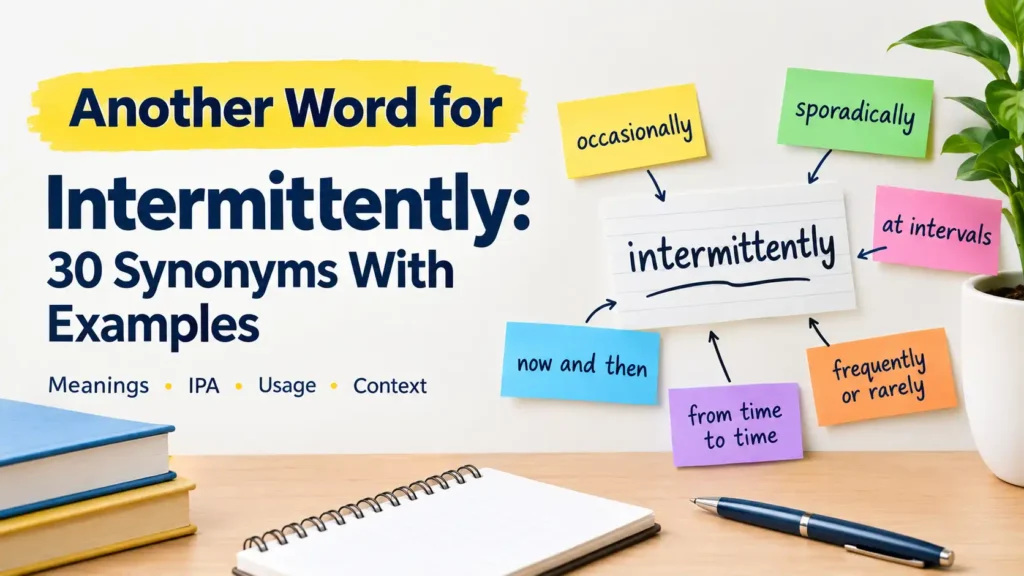
The closest everyday alternatives to intermittently are occasionally, sometimes, sporadically, and on and off. Each word shows that something happens at certain times rather than continuing without a break.
However, the best choice depends on the meaning you want. Some words stress irregular breaks, while others suggest repeated events, set time gaps, or rare activity.
Quick list: Occasionally, sometimes, sporadically, irregularly, periodically, fitfully, erratically, on and off, from time to time, and at intervals.
This guide explores 30 alternatives with meanings, IPA, usage notes, and examples. It also covers word pairs, common phrases, word history, and common word-choice mistakes.
At a Glance: Intermittently Synonyms and Related Alternatives
| Alternative | Part of Speech | Meaning | Register / Tone | Ideal Context |
| Occasionally | Adverb | Sometimes, but not often | Neutral | Everyday speech |
| Sometimes | Adverb | At certain times | Neutral | General use |
| Sporadically | Adverb | At scattered or uneven times | Neutral to formal | Events without a steady pattern |
| Irregularly | Adverb | Without a set pattern | Neutral | Uneven timing |
| Periodically | Adverb | At repeated intervals | Neutral to formal | Recurring events |
| Fitfully | Adverb | In short bursts with breaks | Literary to neutral | Sleep, rain, or work |
| Erratically | Adverb | In an uneven or hard-to-predict way | Neutral | Unsteady actions or results |
| On and off | Adverbial phrase | With breaks between periods | Informal | Work, rain, or contact |
| From time to time | Adverbial phrase | Now and then | Neutral | Everyday events |
| At intervals | Adverbial phrase | With gaps between events | Formal to neutral | Reports and timed events |
These words overlap, but they do not always mean the same thing.
Which Word Should You Use?
| If you want to… | Use | Why |
| Say something happens sometimes | Occasionally | It sounds natural in everyday English. |
| Stress that something lacks a set pattern | Sporadically | It suggests scattered events with uneven gaps. |
| Show repeated events at set times | Periodically | It often suggests a regular cycle. |
| Describe an action with starts and stops | On and off | This phrase sounds clear and natural. |
| Stress uneven timing | Irregularly | It highlights the lack of a steady pattern. |
| Describe brief bursts of activity | Fitfully | It suggests activity that keeps breaking off. |
| Show hard-to-predict changes | Erratically | It stresses an uneven or unpredictable pattern. |
| Describe events separated by gaps | At intervals | This phrase focuses on the spaces between events. |
The main difference lies in timing and pattern. For example, periodically often suggests repeated intervals, while sporadically suggests a less steady pattern.
Exploring the Multiple Meanings of “Intermittently”
Intermittently is an adverb. It means something happens with breaks rather than continuing all the time. The breaks may follow a pattern or occur at uneven times.
1. Happening Occasionally
- Meaning: Something happens now and then, but not all the time.
- Explanation: This sense focuses on how often an event happens. It does not always suggest a clear pattern.
- Example: Our neighbors occasionally invite us over for dinner.
2. Starting and Stopping
- Meaning: An action begins, stops for a while, and then begins again.
- Explanation: This sense highlights breaks in an ongoing action. It often fits work, rain, noise, or machine use.
- Example: The old fan ran intermittently throughout the warm night.
3. Happening at Uneven Times
- Meaning: An event occurs without a steady or clear time pattern.
- Explanation: The gaps between events may change. As a result, the next event may be hard to predict.
- Example: The weak radio signal returned at irregular times.
4. Happening at Repeated Intervals
- Meaning: Something occurs more than once, with gaps between events.
- Explanation: The gaps may follow a rough or set pattern. However, periodically often fits better when the timing is regular.
- Example: The warning light flashed every few minutes.
5. Continuing in Brief Bursts
- Meaning: An action takes place in short periods separated by pauses.
- Explanation: This sense stresses short bursts of activity rather than steady action. The word fitfully often conveys this idea.
- Example: She worked fitfully on her essay between phone calls.
Analyzing 30 Intermittently Alternatives in Detail
Some choices below are direct synonyms. Others are related phrases that fit only certain contexts.
Core Synonyms
1. Occasionally
IPA: US /əˈkeɪʒənəli/ · UK /əˈkeɪʒənəli/
Definition: This means something happens now and then. It also suggests that the event does not happen all the time.
- Usage: This is a close everyday choice. However, it does not always stress starts and stops.
- Example: We occasionally eat dinner at the small cafe near school.
2. Sometimes
IPA: US and UK /ˈsʌmtaɪmz/
Definition: This means something happens at certain times. It also leaves open how often those times occur.
- Usage: This is a simple and common choice. Still, it may not stress breaks in ongoing action.
- Example: My internet sometimes slows down during online classes.
3. Sporadically
IPA: US /spəˈrædɪkli/ · UK /spəˈrædɪkli/
Definition: This means events happen at scattered times. It also suggests that they lack a steady pattern.
- Usage: This is a strong synonym for uneven or scattered events. For example, it fits reports and news.
- Example: Small groups of fans arrived sporadically before the match.
4. Irregularly
IPA: US and UK /ɪˈrɛɡjələrli/
Definition: This means something happens without a fixed pattern. It also stresses uneven timing or spacing.
- Usage: This is a close match when timing lacks order. However, it may refer to habits rather than pauses.
- Example: The bus arrives irregularly during heavy rain.
5. Periodically
IPA: US /ˌpɪriˈɑːdɪkli/ · UK /ˌpɪəriˈɒdɪkli/
Definition: This means something happens again after some time. It also often suggests a repeated cycle or interval.
- Usage: Use this when events recur at set or expected times. Still, it can also mean simply from time to time.
- Example: The school checks its fire alarms periodically throughout the year.
6. Fitfully
IPA: US and UK /ˈfɪtfəli/
Definition: This means something happens in short bursts with breaks. It also often suggests weak or uneven effort.
- Usage: This word fits sleep, work, rain, or light. However, it can sound more literary than sometimes.
- Example: He slept fitfully while the storm rattled the windows.
Words That Stress Uneven Timing
7. Erratically
IPA: US and UK /ɪˈrætɪkli/
Definition: This means something happens in an uneven or hard-to-predict way. It also suggests a lack of steady control.
- Usage: This word fits actions or results that change without warning. However, it can suggest disorder more than simple breaks.
- Example: The old car ran erratically on cold mornings.
8. Spasmodically
IPA: US /spæzˈmɑːdɪkli/ · UK /spæzˈmɒdɪkli/
Definition: This means something happens in sudden bursts with pauses. It also suggests short, uneven periods of activity.
- Usage: This word is more formal than on and off. It often fits movement, effort, or sudden activity.
- Example: The machine shook spasmodically before it came to a stop.
9. Unevenly
IPA: US and UK /ʌnˈiːvənli/
Definition: This means something happens without a smooth or equal pattern. It also points to differences in timing, amount, or pace.
- Usage: This is a related choice when events vary in pace. However, it does not always mean they stop and start.
- Example: Rain fell unevenly across the dry fields.
10. Fitfully and Irregularly
IPA: US and UK /ˈfɪtfəli ænd ɪˈrɛɡjələrli/
Definition: This phrase combines brief bursts with uneven timing. It also stresses that activity lacks a smooth flow.
- Usage: This is a descriptive phrase, not a single-word synonym. Use it when both pauses and uneven timing matter.
- Example: The team worked fitfully and irregularly during the busy week.
Everyday Phrases
11. On and Off
IPA: US and UK /ˌɑːn ən ˈɔːf/
Definition: This means something happens for a while, stops, and then returns. It also often suggests repeated breaks.
- Usage: This is a natural informal choice. For example, it fits rain, work, pain, or contact.
- Example: It rained on and off during our trip.
12. Off and On
IPA: US and UK /ˌɔːf ən ˈɑːn/
Definition: This means something occurs with breaks between periods. It also carries much the same sense as on and off.
- Usage: This is a close phrase-level synonym. However, some speakers use on and off more often.
- Example: She studied off and on until the test began.
13. From Time to Time
IPA: US and UK /frəm ˌtaɪm tə ˈtaɪm/
Definition: This means something happens now and then. It also suggests that the event is not constant.
- Usage: This phrase sounds natural in speech and writing. Still, it does not stress uneven breaks as strongly.
- Example: We visit our cousins from time to time.
14. Now and Then
IPA: US and UK /ˌnaʊ ən ˈðɛn/
Definition: This means something happens on some occasions. It also gives a relaxed sense of occasional activity.
- Usage: This is an informal, everyday choice. For example, it works well for habits and visits.
- Example: I still play chess with my uncle now and then.
15. Now and Again
IPA: US and UK /ˌnaʊ ən əˈɡɛn/
Definition: This means something happens from time to time. It also carries much the same meaning as now and then.
- Usage: This phrase is common in British English. However, speakers in other regions understand it too.
- Example: We hear from our old teacher now and again.
16. Every So Often
IPA: US and UK /ˌɛvri soʊ ˈɔːfən/
Definition: This means something happens at certain times. It also suggests that the events are spread out.
- Usage: This phrase fits relaxed, everyday speech. Still, it does not say If the gaps are regular.
- Example: Every so often, the lights flicker during a storm.
17. Once in a While
IPA: US and UK /ˌwʌns ɪn ə ˈwaɪl/
Definition: This means something happens occasionally. It also suggests that the event is not common.
- Usage: This is an everyday phrase for rare or occasional events. However, it does not stress repeated stopping and starting.
- Example: We order pizza once in a while on Fridays.
18. At Times
IPA: US and UK /ət ˈtaɪmz/
Definition: This means something happens during some periods. It also points to moments when a condition or action occurs.
- Usage: This phrase is a broad alternative. For example, it fits moods, weather, or changing conditions.
- Example: The road gets slippery at times during winter.
Phrases That Focus on Gaps or Frequency
19. At Intervals
IPA: US and UK /ət ˈɪntərvəlz/
Definition: This means events happen with spaces of time between them. It also draws attention to the gaps.
- Usage: This phrase often suits formal or factual writing. However, the gaps may be regular or irregular.
- Example: The guard checked each door at intervals throughout the night.
20. In Fits and Starts
IPA: US and UK /ɪn ˌfɪts ən ˈstɑːrts/
Definition: This means something proceeds in bursts with pauses. It also suggests that progress lacks a smooth flow.
- Usage: This established phrase often fits work or progress. Still, it may suggest frustration or poor results.
- Example: The group worked in fits and starts on the project.
21. Infrequently
IPA: US and UK /ɪnˈfriːkwəntli/
Definition: This means something does not happen often. It also puts more stress on low frequency than on breaks.
- Usage: This is related to intermittently, but not an exact match. Use it when rarity matters most.
- Example: The town bus runs infrequently after the evening rush.
22. Rarely
IPA: US and UK /ˈrɛrli/
Definition: This means something happens very few times. It also suggests that the event is uncommon.
- Usage: This word stresses low frequency rather than repeated starts and stops. However, it can be replaced intermittently in some cases.
- Example: We rarely see snow in our part of the country.
23. Seldom
IPA: US and UK /ˈsɛldəm/
Definition: This means something does not happen often. It also carries much the same sense as rarely.
- Usage: This word sounds a little more formal or literary. Still, it remains clear in everyday writing.
- Example: The old shop seldom opens before noon.
24. Occasionally at Intervals
IPA: US and UK /əˈkeɪʒənəli ət ˈɪntərvəlz/
Definition: This phrase means an event happens now and then with gaps between events. It also stresses that the activity is not constant.
- Usage: This is a descriptive phrase, not a fixed synonym. Use it only when both ideas matter.
- Example: The alarm sounded occasionally at intervals during the test.
Words for Repeated or Broken Activity
25. Repeatedly
IPA: US and UK /rɪˈpiːtɪdli/
Definition: This means something happens more than once. It also stresses that an act or event occurs again.
- Usage: This is a related choice, not an exact synonym. It does not say If breaks occur between events.
- Example: The phone rang repeatedly while I was cooking dinner.
26. Recurrently
IPA: US and UK /rɪˈkɜːrəntli/
Definition: This means something happens again over time. It also suggests that the event returns more than once.
- Usage: This word often appears in formal or medical writing. However, it stresses return rather than the gaps between events.
- Example: The same fault recurred recurrently in the old system.
27. Continuously
IPA: US and UK /kənˈtɪnjuəsli/
Definition: This means something happens without a break. It also marks the opposite of stop-and-start activity.
- Usage: This is not a synonym for intermittently. Instead, use it as a contrast when action does not pause.
- Example: The pump ran continuously throughout the long test.
28. Constantly
IPA: US and UK /ˈkɑːnstəntli/
Definition: This means something happens all the time or very often. It also stresses steady or frequent activity.
- Usage: This is usually an opposite or contrast, not a synonym. However, casual speech sometimes uses it to mean very often.
- Example: The fan ran constantly during the heat wave.
29. Occasionally and Irregularly
IPA: US and UK /əˈkeɪʒənəli ænd ɪˈrɛɡjələrli/
Definition: This phrase means something happens now and then without a fixed pattern. It also stresses both low frequency and uneven timing.
- Usage: This is a descriptive phrase rather than a single synonym. Use it when both features matter.
- Example: The old radio worked occasionally and irregularly during the storm.
30. Sporadically Over Time
IPA: US and UK /spəˈrædɪkli ˌoʊvər ˈtaɪm/
Definition: This phrase means events occur at scattered points across a period. It also stresses the lack of a steady pattern.
- Usage: This is a related phrase, not a single-word synonym. It fits reports about activity spread across a longer period.
- Example: The town saw sporadically over time several small power cuts.
Intermittently vs. Periodically vs. Sporadically
These three words overlap, but each highlights a different feature of an event. The main difference is If the word stresses breaks, timing, or an uneven pattern.
| Word | Main Idea | Timing Pattern | Example |
| Intermittently | Activity stops and starts | Regular or irregular gaps | The power failed intermittently during the storm. |
| Periodically | An event returns at intervals | Often regular or expected | The system restarts periodically to clear errors. |
| Sporadically | Events occur at scattered times | Uneven and often unpredictable | Birds appeared sporadically across the field. |
When should you choose each word?
- Use intermittently when something starts and stops over time.
- Choose periodically when an event returns at regular or expected intervals.
- Pick sporadically when events happen at scattered times without a steady pattern.
For example, a machine that runs for ten minutes and stops for five may work intermittently. A machine that starts every hour operates periodically. If it starts at unpredictable times, sporadically may fit better.
Intermittently and Opposite/Paired Word Pairs
| Word | Paired Word | Note |
| Intermittently | Continuously | With breaks versus without breaks |
| Intermittently | Constantly | At intervals versus all the time |
| Occasionally | Frequently | Now and then versus often |
| Sporadically | Regularly | At scattered times versus in a steady pattern |
| Irregularly | Regularly | Without a set pattern versus with a set pattern |
| Periodically | Continuously | At intervals versus without a break |
| Fitfully | Steadily | In short bursts versus at a steady pace |
| On and off | Without interruption | With breaks versus with no breaks |
These pairs help show the main idea behind each word. However, the best opposite depends on the sentence. For example, regularly contrasts with irregularly, while continuously contrasts with activity that stops and starts.
Common Word Partners of “Intermittently”
Collocations are words that often appear together. These common patterns help you use them intermittently in natural English.
| Pattern | Common Partners | Example |
| Verb + intermittently | Work, run, operate | The backup pump runs intermittently. |
| Verb + intermittently | Appear, occur, happen | Bright lights appeared intermittently in the sky. |
| Verb + intermittently | Continue, function | The service continued intermittently after the storm. |
| Weather + intermittently | Rain, snow | Rain fell intermittently throughout the afternoon. |
| Sound + intermittently | Flash, beep, ring | The warning light flashed intermittently. |
| Health + intermittently | Pain, cough | He experienced pain intermittently during the week. |
| Communication + intermittently | Connect, transmit | The device connected intermittently to the network. |
| Time phrase + intermittently | Throughout the day, over several years | The team met intermittently over several years. |
These patterns cover common uses in daily life and formal writing. Choose a verb that matches the action, then add intermittently to show its stop-and-start pattern.
Idiomatic Phrases Featuring “Intermittently”
There are few common idioms built around the exact word intermittently. However, several established expressions convey a similar idea.
1. On and Off
- Meaning: Something happens for a while, stops, and then starts again.
- Example: It rained on and off during our weekend trip.
2. In Fits and Starts
- Meaning: Something happens in short bursts with breaks between them.
- Example: Progress comes in fits and starts during the first month.
3. Off and On
- Meaning: Something occurs at different times, with pauses in between.
- Example: The two friends kept in touch off and on for years.
4. Every Now and Then
- Meaning: Something happens occasionally rather than all the time.
- Example: Every now and then, our old clock stops working.
These expressions work well in everyday English. Still, in fits and starts often stresses broken progress, while on and off fits repeated periods of activity.
Word Formation of “Intermittently”
Etymology and Structure
Intermittently comes from the adjective intermittent with the adverb ending -ly. The adjective traces back to Latin intermittere, meaning to leave a gap or stop for a time.
The word has three main parts:
- Inter-: A Latin element linked to the idea of being between.
- Mit: Part of the Latin root found in intermittere.
- -ly: An ending that often turns an adjective into an adverb.
The modern word means something happens with breaks or gaps. Its structure helps explain why it refers to activity that stops and starts.
Date and History
The related adjective intermittent first appeared in English around 1595–1605, according to Dictionary.com. The adverb intermittently formed from that adjective and the ending -ly.
Word Class Variations
| Word | Part of Speech | Meaning |
| Intermit | Verb | To stop for a time |
| Intermittent | Adjective | Stopping and starting at intervals |
| Intermittently | Adverb | In a way that stops and starts |
| Intermittence | Noun | The state of stopping and starting |
| Intermittency | Noun | The quality of occurring with breaks |
The adverb intermittently modifies verbs and tells readers how an action occurs. For example, a device may work intermittently or rain may fall intermittently.
Common Word-Choice Mistakes
Here are six common mistakes to avoid when choosing an alternative to intermittently.
- Wrong: The machine worked continuously, with long breaks. Correction: The machine worked intermittently, with long breaks.
- Wrong: The event happened periodically at random times. Correction: The event happened sporadically at random times.
- Wrong: The bus ran occasionally every ten minutes. Correction: The bus ran regularly every ten minutes.
- Wrong: The alarm rang intermittently without ever stopping. Correction: The alarm rang continuously without stopping.
- Wrong: She rarely called me several times a day. Correction: She frequently called me several times a day.
- Wrong: The lights flashed constantly, with long pauses between flashes. Correction: The lights flashed intermittently, with long pauses between flashes.
Remember that frequency and timing are different ideas. For example, rarely tells readers how often something happens, while intermittently stresses breaks in activity.
Frequently Asked Questions
1. What is the closest synonym for intermittently?
Occasionally, sporadically, and on and off are close alternatives. However, on and off best stresses repeated starts and stops.
2. What is a simple word for intermittently?
Sometimes it is a simple, common choice. Still, it may not show that an action stops and starts.
3. Is intermittently the same as occasionally?
They overlap, but they are not always identical. Occasionally stresses frequency, while intermittently often stresses breaks in activity.
4. What is a formal alternative to intermittently?
Periodically or sporadically may fit formal writing. Choose periodically for repeated intervals and sporadically for scattered events.
5. What is the difference between intermittently and sporadically?
Intermittently stresses breaks between periods of activity. Sporadically stresses scattered events without a steady pattern.
6. What is the difference between intermittently and periodically?
Periodically often suggests regular or expected intervals. Intermittently allows both regular and irregular breaks.
7. What is the opposite of intermittently?
Continuously is a common opposite. Constantly can also work when you mean something happens all the time.
8. Can intermittently describe machines?
Yes. People often use it for machines that work, stop, and start again.
9. Can intermittently describe weather?
Yes. For example, rain may fall intermittently throughout the day, with dry periods between showers.
10. Is on and off a good replacement for intermittently?
Yes, especially in casual speech. However, intermittently may sound more suitable in formal reports.
Conclusion
The best alternatives to intermittently include occasionally, sometimes, sporadically, irregularly, and on and off. Each word offers a slightly different way to express activity that occurs with breaks.
However, context matters. Periodically often suggests repeated intervals, while sporadically points to scattered events. Meanwhile, continuously means without a break, so it expresses the opposite idea.
To choose the right word, consider how often something happens and If its timing follows a pattern. Then pick the term that conveys your meaning in the clearest way.

Sikandar Hayat is the author of PublivoHub.com, a platform dedicated to synonyms, alternative words, and vocabulary improvement. He aims to help readers find the right words and express their ideas more clearly and effectively. Through simple explanations and useful word alternatives, Sikandar makes it easier for students, writers, bloggers, and everyday readers to improve their writing and expand their vocabulary.