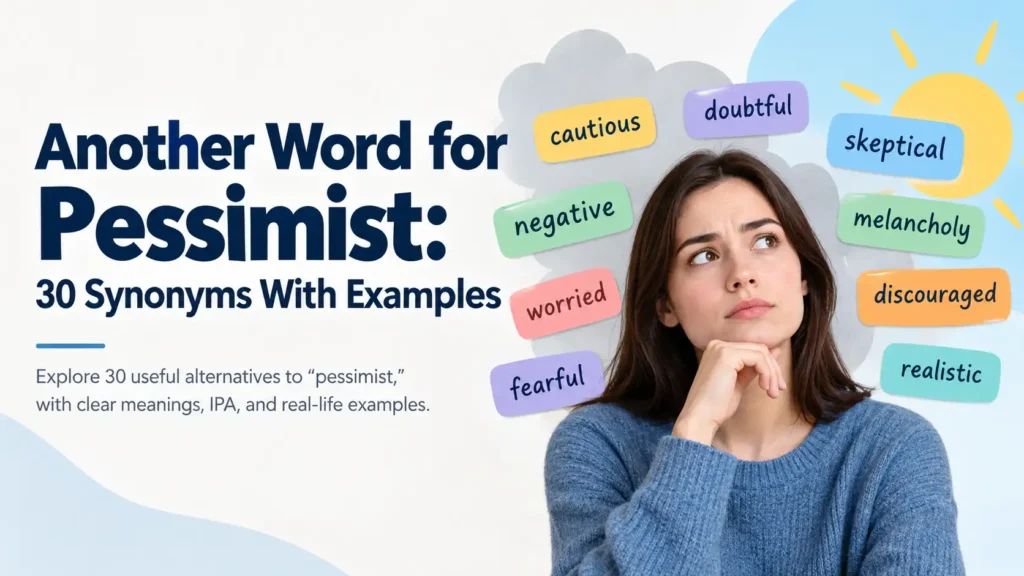
A pessimist is someone who expects bad things to happen or often sees the worst side of life. Common alternatives include defeatist, cynic, worrier, and gloomy person. However, each word has a slightly different meaning.
For example, a defeatist expects failure and may give up easily. A cynic doubts people’s good intentions, while a worrier often feels concerned about what might go wrong. Therefore, the best word depends on the person’s outlook and actions.
Quick list: Defeatist, cynic, worrier, gloomy person, doomster, doom-monger, prophet of doom, killjoy, wet blanket, and naysayer.
This guide explores 30 alternatives with meanings, IPA, usage notes, and examples. It also explains common word pairs, expressions, word origins, and mistakes to avoid.
At a Glance: Pessimist Synonyms and Related Alternatives
| Alternative | Part of Speech | Meaning | Register / Tone | Ideal Context |
| Defeatist | Noun | Someone who expects failure | Critical | Giving up before trying |
| Cynic | Noun | Someone who doubts people’s motives | Neutral or critical | Distrust of others |
| Worrier | Noun | Someone who often feels concern | Informal | Everyday concerns |
| Gloomy person | Noun phrase | Someone who often feels or spreads gloom | Informal | General mood |
| Doomster | Noun | Someone who predicts bad outcomes | Informal | Public warnings |
| Doom-monger | Noun | Someone who spreads fear of disaster | Critical | Alarming claims |
| Prophet of doom | Noun phrase | Someone who predicts disaster | Figurative | Grim forecasts |
| Killjoy | Noun | Someone who spoils other people’s fun | Critical | Social events |
| Wet blanket | Noun phrase | Someone who dampens others’ excitement | Informal | Group plans |
| Naysayer | Noun | Someone who often opposes ideas | Critical | Plans and proposals |
These words overlap with pessimist, but they are not exact matches in every context.
Which Word Should You Use?
| If you want to… | Use | Why |
| Describe someone who expects failure | Defeatist | It stresses a lack of faith in success. |
| Describe someone who expects bad outcomes | Pessimist | It is the clearest and most direct word. |
| Show doubt about people’s motives | Cynic | It focuses on distrust rather than bad predictions. |
| Describe someone who worries a lot | Worrier | It focuses on concern and fear. |
| Describe someone who predicts disaster | Prophet of doom | It adds a strong, dramatic tone. |
| Describe someone who rejects new ideas | Naysayer | It focuses on opposition and doubt. |
| Describe someone who spoils the fun | Killjoy | It focuses on other people’s enjoyment. |
| Describe someone who spreads gloomy views | Doom-monger | It suggests repeated warnings about bad events. |
Exploring the Multiple Meanings of “Pessimist”
The word pessimist has two main uses. One refers to a person’s outlook, while the other refers to a belief about life.
1. Someone Who Expects Bad Outcomes
- Meaning: A pessimist thinks bad things are more likely than good things.
- Explanation: This is the most common meaning. The person often expects problems instead of success.
- Example: Maya is a pessimist who expects every trip to go wrong.
2. Someone Who Focuses on the Bad Side
- Meaning: A pessimist pays more attention to problems than benefits.
- Explanation: The person may notice real risks but overlook good signs. They also tend to judge events by their possible downsides.
- Example: My brother saw only the risks in our new business plan.
3. Someone Who Doubts Success
- Meaning: A pessimist has little hope that a plan will work.
- Explanation: This sense often appears in work, school, and sports. It can overlap with defeatist, but the words have different shades of meaning.
- Example: The pessimist thought our team had no chance of winning.
4. A Person Who Holds a Pessimistic View of Life
- Meaning: A pessimist believes life often brings more trouble than joy.
- Explanation: This use can reflect a broad view of human life. It also appears in discussions of philosophy.
- Example: The writer’s pessimism shaped his view of human nature.
Analyzing 30 Pessimist Alternatives in Detail
Some words below are close synonyms for pessimists. Others fit only certain traits, actions, or social settings.
Core Synonyms
1. Defeatist
IPA: US /dɪˈfiːtɪst/ · UK /dɪˈfiːtɪst/
Definition: A defeatist expects failure before trying. The word also suggests a lack of faith in success.
- Usage: It is more critical than pessimist. However, it often suggests giving up too soon.
- Example: The defeatist wanted to quit before the match even began.
2. Cynic
IPA: US /ˈsɪnɪk/ · UK /ˈsɪnɪk/
Definition: A cynic doubts that people act from good motives. The word also suggests distrust of kindness or honesty.
- Usage: A cynic may also be a pessimist. However, cynicism focuses on people’s motives.
- Example: The cynic thought the gift was only a trick for praise.
3. Worrier
IPA: US and UK /ˈwɜːriər/
Definition: A worrier often feels uneasy about what might happen. The word also fits people who dwell on small risks.
- Usage: This is a common, gentle term. However, a worrier need not expect every outcome to be bad.
- Example: As a worrier, Nina checked the weather before every trip.
4. Doubter
IPA: US and UK /ˈdaʊtər/
Definition: A doubter finds it hard to believe a claim or outcome. The word also shows a lack of trust in certainty.
- Usage: It is broader than pessimism. For example, a doubter may question facts without expecting failure.
- Example: The doubter asked if our plan could really work.
5. Skeptic
IPA: US /ˈskɛptɪk/ · UK /ˈskɛptɪk/
Definition: A skeptic asks for proof before accepting a claim. The word also suggests a careful, questioning mind.
- Usage: This is not an exact synonym. However, a skeptic may doubt good outcomes when proof seems weak.
- Example: The skeptic wanted more facts before backing the new plan.
Words for Gloom and Bad Outlooks
6. Gloomy Person
IPA: US and UK /ˈɡluːmi ˈpɜːrsən/
Definition: A gloomy person often seems sad or expects poor results. The phrase also fits someone who brings a dark mood.
- Usage: This is an informal description, not a fixed noun. Still, it works in everyday speech.
- Example: The gloomy person thought the picnic would end in rain.
7. Melancholic
IPA: US /ˌmɛlənˈkɑːlɪk/ · UK /ˌmelənˈkɒlɪk/
Definition: A melancholic person often feels deep sadness. The word also refers to a sad or thoughtful mood.
- Usage: It is more about sadness than bad predictions. However, some melancholic people may also seem pessimistic.
- Example: The melancholic poet wrote about lost hope and fading joy.
8. Gloom Merchant
IPA: US and UK /ɡluːm ˈmɜːrtʃənt/
Definition: A gloom merchant often spreads bleak views or bad news. The phrase also suggests a habit of stressing trouble.
- Usage: This informal term often sounds critical. In fact, it suggests someone keeps bringing others down.
- Example: Our gloom merchant said the fair would fail before it opened.
9. Doomster
IPA: US and UK /ˈduːmstər/
Definition: A doomster often predicts failure, ruin, or disaster. The word also suggests a strong focus on bad outcomes.
- Usage: It is informal and less common than pessimism. However, it suits talk about grim forecasts.
- Example: The doomster predicted that the new shop would close within months.
10. Doom-Monger
IPA: US and UK /ˈduːmˌmʌŋɡər/
Definition: A doom-monger spreads claims about a coming disaster. The word also suggests that someone stirs up fear.
- Usage: This term is strongly critical. For example, people may use it for alarmist public claims.
- Example: The reporter called the speaker a doom-monger after his grim speech.
Words for Opposition and Low Hope
11. Naysayer
IPA: US and UK /ˈneɪˌseɪər/
Definition: A naysayer often says no to plans or ideas. The word also suggests a habit of finding fault.
- Usage: It is not an exact synonym. Still, naysayers often sound pessimistic when they reject new plans.
- Example: The naysayer said our school club would never attract new members.
12. Fatalist
IPA: US /ˈfeɪtəlɪst/ · UK /ˈfeɪtəlɪst/
Definition: A fatalist believes events cannot easily be changed. The word also suggests that some outcomes are already set.
- Usage: A fatalist is not always a pessimist. However, both may feel that bad outcomes are hard to avoid.
- Example: The fatalist believed the result would come, no matter what we did.
13. Doomsayer
IPA: US and UK /ˈduːmˌseɪər/
Definition: A doomsayer predicts disaster or great harm. The word also suggests repeated warnings about a bleak future.
- Usage: This word is close to the prophet of doom. However, it stresses the act of making grim predictions.
- Example: The doomsayer warned that the town faced a hard winter.
14. Pessimistic Thinker
IPA: US and UK /ˌpesɪˈmɪstɪk ˈθɪŋkər/
Definition: A pessimistic thinker tends to expect poor results. The phrase also points to a person’s way of judging events.
- Usage: This phrase is clear and neutral. For example, it suits essays or plain descriptions.
- Example: The pessimistic thinker saw more risks than chances in the plan.
15. Defeatist Thinker
IPA: US and UK /dɪˈfiːtɪst ˈθɪŋkər/
Definition: A defeatist thinker expects to lose or fail. The phrase also suggests low trust in one’s own effort.
- Usage: This phrase is more about giving up than gloom. However, it can explain a pessimistic view of success.
- Example: The defeatist thinker assumed the hard test would be impossible.
Informal and Figurative Alternatives
16. Prophet of Doom
IPA: US and UK /ˈprɑːfɪt əv duːm/
Definition: A prophet of doom predicts trouble or disaster. The phrase also paints the speaker as a source of grim news.
- Usage: This is a figurative phrase, often used with a critical tone. It is common in news and daily speech.
- Example: The prophet of doom said the storm would ruin the whole event.
17. Cassandra
IPA: US and UK /kəˈsændrə/
Definition: A Cassandra is someone who warns of danger but gets ignored. The name also refers to a person whose grim warnings later prove right.
- Usage: This is a literary allusion, not a general synonym. However, it fits a pessimist whose warnings come true.
- Example: She felt like Cassandra when her warnings about the flood went unheard.
18. Wet Blanket
IPA: US and UK /ˌwet ˈblæŋkɪt/
Definition: A wet blanket spoils fun or dampens excitement. The phrase also suggests someone who makes others less eager.
- Usage: This informal term is related, not exact. In fact, a person can spoil fun without expecting bad outcomes.
- Example: Don’t be a wet blanket about our class party.
19. Killjoy
IPA: US and UK /ˈkɪlˌdʒɔɪ/
Definition: A killjoy stops others from having fun. The word also suggests a person who spoils a happy mood.
- Usage: It focuses on fun rather than outlook. Still, a pessimist may seem like a killjoy when they reject every plan.
- Example: The killjoy said our game night would be boring.
20. Sourpuss
IPA: US and UK /ˈsaʊərˌpʊs/
Definition: A sourpuss is someone who seems grumpy or unhappy. The word also suggests a person who rarely shows joy.
- Usage: This is informal and often teasing. However, it does not always mean the person expects bad results.
- Example: Stop being a sourpuss and enjoy the family meal.
Words for Distrust and Grim Views
21. Misanthrope
IPA: US /ˈmɪsənˌθroʊp/ · UK /ˈmɪsənˌθrəʊp/
Definition: A misanthrope dislikes people or avoids human company. The word also suggests deep distrust or dislike of human nature.
- Usage: It is not an exact synonym. However, a misanthrope may hold a bleak view of people.
- Example: The misanthrope avoided crowds and doubted most people’s kindness.
22. Scoffer
IPA: US and UK /ˈskɔːfər/
Definition: A scoffer mocks ideas or beliefs. The word also suggests a person who shows open scorn.
- Usage: It focuses on mockery, not pessimism. Still, scoffers may mock hopeful plans or claims.
- Example: The scoffer laughed when the team spoke about winning.
23. Grumbler
IPA: US and UK /ˈɡrʌmblər/
Definition: A grumbler often complains about things. The word also suggests a habit of finding fault with daily life.
- Usage: This is an informal term for a person who complains. However, grumbling alone does not make someone a pessimist.
- Example: The grumbler complained about the food, the music, and the seats.
24. Complainer
IPA: US and UK /kəmˈpleɪnər/
Definition: A complainer often speaks about things they dislike. The word also suggests a focus on problems or poor results.
- Usage: It is broader than pessimism. For example, a complainer may dislike a real problem without expecting more trouble.
- Example: The complainer said the bus was late again.
25. Alarmist
IPA: US /əˈlɑːrmɪst/ · UK /əˈlɑːmɪst/
Definition: An alarmist makes a danger seem worse or more likely. The word also suggests that someone stirs up fear.
- Usage: It is a related term, not an exact synonym. However, an alarmist may predict harm without enough proof.
- Example: The alarmist claimed one rainy day would ruin the whole season.
More Context-Specific Alternatives
26. Naysaying Critic
IPA: US and UK /ˈneɪˌseɪɪŋ ˈkrɪtɪk/
Definition: A naysaying critic often finds faults in plans or ideas. The phrase also suggests a habit of rejecting new options.
- Usage: This is a descriptive phrase rather than a fixed synonym. Still, it fits someone who often expects plans to fail.
- Example: The naysaying critic dismissed our idea before hearing the full plan.
27. Doubting Thomas
IPA: US and UK /ˌdaʊtɪŋ ˈtɑːməs/
Definition: A doubting Thomas is someone who needs proof before believing. The phrase also suggests strong doubt about a claim.
- Usage: This familiar expression is related, not exact. For example, a doubting Thomas may accept good news after seeing proof.
- Example: My brother was doubting Thomas until he saw the results.
28. Grump
IPA: US and UK /ɡrʌmp/
Definition: A grump is someone who often seems cross or unhappy. The word also fits a person who complains a lot.
- Usage: This is informal and often playful. However, a grump may have a bad mood without a pessimistic outlook.
- Example: The old grump complained when we turned on the music.
29. Jeremiah
IPA: US and UK /ˌdʒerəˈmaɪə/
Definition: Jeremiah is someone who gives grim warnings about the future. The name also links to the idea of a prophet of doom.
- Usage: This is a literary term and may sound dated. Still, it fits a person who keeps predicting trouble.
- Example: The columnist became a Jeremiah by warning of disaster in every speech.
30. Pollyanna’s Opposite
IPA: US and UK /ˌpɑːliˈænəz ˈɑːpəzɪt/
Definition: This phrase means someone who expects the worst instead of seeing the bright side. It also gives a simple contrast with an overly hopeful person.
- Usage: This is a descriptive phrase, not a standard synonym. For example, use it when explaining a contrast in outlook.
- Example: Unlike a Pollyanna, he expected the plan to fail from the start.
Pessimist vs. Cynic vs. Defeatist
These three words can sound alike, but they focus on different traits. Choosing the right one helps you express your meaning more clearly.
| Word | Main Focus | Example |
| Pessimist | Expects bad outcomes | He thinks the trip will go wrong. |
| Cynic | Doubts people’s motives | He thinks the offer hides a selfish goal. |
| Defeatist | Expects failure and may give up | He refuses to enter the race because he expects to lose. |
| Worrier | Often feels concern | She worries about every small delay. |
| Naysayer | Often rejects ideas | He says no to every new plan. |
| Fatalist | Believes events cannot easily change | She thinks the result is beyond her control. |
In short: A pessimist expects bad results, a cynic doubts people’s motives, and a defeatist expects failure. However, one person can show all three traits in different cases.
Pessimist and Opposite/Paired Word Pairs
These words often appear in contrast with pessimism or help explain a person’s outlook.
| Word | Paired Word | Note |
| Pessimist | Optimist | Expects bad outcomes versus good ones |
| Pessimism | Optimism | A bleak outlook versus a hopeful outlook |
| Pessimistic | Optimistic | Expects the worst versus expects the best |
| Defeatist | Determined person | Expects failure versus keeps trying |
| Cynic | Idealist | Doubts good motives versus values high ideals |
| Worrier | Calm person | Often feels concern versus stays at ease |
| Naysayer | Supporter | Rejects ideas versus backs them |
| Gloomy | Cheerful | Shows sadness versus joy |
An optimist is the clearest opposite of a pessimist. However, the best paired word depends on the trait you want to discuss.
Common Word Partners of “Pessimist”
These common word partners help you use pessimism in natural English.
| Pattern | Common Partners | Example |
| Adjective + pessimist | natural pessimist, lifelong pessimist | He is a natural pessimist about work. |
| Verb + pessimist | call someone a pessimist, seem like a pessimist | They call him a pessimist after every meeting. |
| Pessimist + verb | pessimist believes, pessimist expects | A pessimist expects more trouble. |
| Group + pessimist | political pessimist, economic pessimist | The economic pessimist expects slow growth. |
| Pessimist + outlook | pessimist’s outlook, pessimist’s view | Her outlook changed after the good news. |
| Pessimist + forecast | pessimist’s forecast, pessimists’ forecast | The pessimists’ forecast proved too bleak. |
| Pessimist + phrase | natural pessimist, confirmed pessimist | He calls himself a confirmed pessimist. |
Idiomatic Phrases Featuring “Pessimist”
English has few fixed expressions that contain the exact word pessimist. However, several established phrases describe a pessimistic outlook.
1. Prophet of Doom
- Meaning: Someone who keeps predicting disaster or failure.
- Example: Our prophet of doom said the new plan would never work.
2. The Glass Is Half Empty
- Meaning: A way to show a focus on what is missing rather than what remains.
- Example: He sees the glass as half empty when plans go wrong.
3. Doom and Gloom
- Meaning: A mood or message full of worry about bad events.
- Example: The news report was full of doom and gloom about the economy.
4. See the Dark Side
- Meaning: Focus on the bad parts of a person, plan, or event.
- Example: She tends to see the dark side of every new idea.
These expressions do not all mean pessimists on their own. Still, each can help explain a gloomy outlook or a habit of expecting trouble.
Word Formation of “Pessimist”
Etymology & Structure
The word pessimist entered English through French pessimiste. It comes from pessimism with the suffix -ist, which often refers to a person who holds a belief.
The deeper root is Latin pessimus, meaning “worst.” The word links to the idea of seeing the worst side of life.
Date and History
Etymology records the English noun pessimist from around 1820. The word first referred to someone who expected the worst or held a bleak view of life.
The related noun pessimism appeared earlier in English. Its meaning later grew to cover a broad view of life and human nature.
Word Class Variations
| Word | Part of Speech | Meaning |
| Pessimist | Noun | A person who expects bad outcomes |
| Pessimism | Noun | The habit or belief of expecting the worst |
| Pessimistic | Adjective | Expecting bad results |
| Pessimistically | Adverb | In a way that expects bad results |
| Optimist | Noun | A person who expects good outcomes |
| Optimism | Noun | A hopeful view of life |
| Optimistic | Adjective | Expecting good results |
| Optimistically | Adverb | In a hopeful way |
Common Word-Choice Mistakes
Here are common mistakes to avoid when choosing a word for pessimist.
- Wrong pairing: Pessimist for someone who doubts only one claim. Correction: Use skeptic when doubt is the main trait.
- Wrong pairing: Cynic for every person who expects bad luck. Correction: Use pessimism for a general habit of expecting poor results.
- Wrong pairing: Defeatist for every cautious person. Correction: Use defeatist when someone expects failure and may give up.
- Wrong pairing: Worrier for someone who always rejects ideas. Correction: Use naysayer when repeated opposition is the main trait.
- Wrong pairing: Killjoy for anyone who dislikes bad news. Correction: Use killjoy for someone who spoils other people’s fun.
- Wrong pairing: Fatalist for anyone who expects trouble. Correction: Use fatalist when someone believes events cannot easily change.
- Wrong pairing: Melancholic for anyone who predicts disaster. Correction: Use doomsayer when making grim predictions is the main trait.
Frequently Asked Questions
1. What Is the Closest Synonym for Pessimist?
Defeatist is a close choice when someone expects failure. However, pessimist remains the clearest word for someone who expects bad outcomes.
2. What Is a More Formal Word for Pessimist?
Defeatist or cynic may fit formal writing. Choose defeatist for expected failure and cynic for distrust of people’s motives.
3. What Is the Opposite of a Pessimist?
An optimist is the clearest opposite. An optimist tends to expect good outcomes rather than bad ones.
4. Is a Cynic the Same as a Pessimist?
No. A cynic doubts people’s motives, while a pessimist expects bad outcomes. Still, one person may show both traits.
5. Is a Defeatist the Same as a Pessimist?
Not quite. A defeatist expects failure and may stop trying. A pessimist expects poor results but may keep working.
6. What Is a Funny Word for a Pessimist?
Gloom merchant, sourpuss, and doomster can sound playful or teasing. However, their tone depends on the speaker and setting.
7. What Is a Word for Someone Who Always Expects the Worst?
Pessimist is the most direct choice. You can also use doomster when the person often predicts trouble.
8. What Is a Word for Someone Who Doubts Everything?
Doubter is a broad choice. Use skeptic when someone asks for proof before accepting a claim.
9. Can a Pessimist Also Be an Optimist?
Yes, a person’s outlook can change with the topic or setting. Someone may expect trouble at work but feel hopeful about family life.
10. What Is the Difference Between Pessimism and Melancholy?
Pessimism involves expecting bad outcomes or focusing on life’s problems. Melancholy refers more to sadness or a thoughtful, low mood.
Conclusion
The closest alternatives to pessimist include defeatist, cynic, worrier, and doubter. Each word points to a different trait, from expecting failure to doubting people’s motives.
However, related words are not always exact synonyms. Killjoy focuses on spoiled fun, while doomsayer focuses on grim predictions.
To choose the right word, think about what the person does or believes. Use pessimist for a general outlook, defeatist for expected failure, and cynic for distrust of others.

Sikandar Hayat is the author of PublivoHub.com, a platform dedicated to synonyms, alternative words, and vocabulary improvement. He aims to help readers find the right words and express their ideas more clearly and effectively. Through simple explanations and useful word alternatives, Sikandar makes it easier for students, writers, bloggers, and everyday readers to improve their writing and expand their vocabulary.