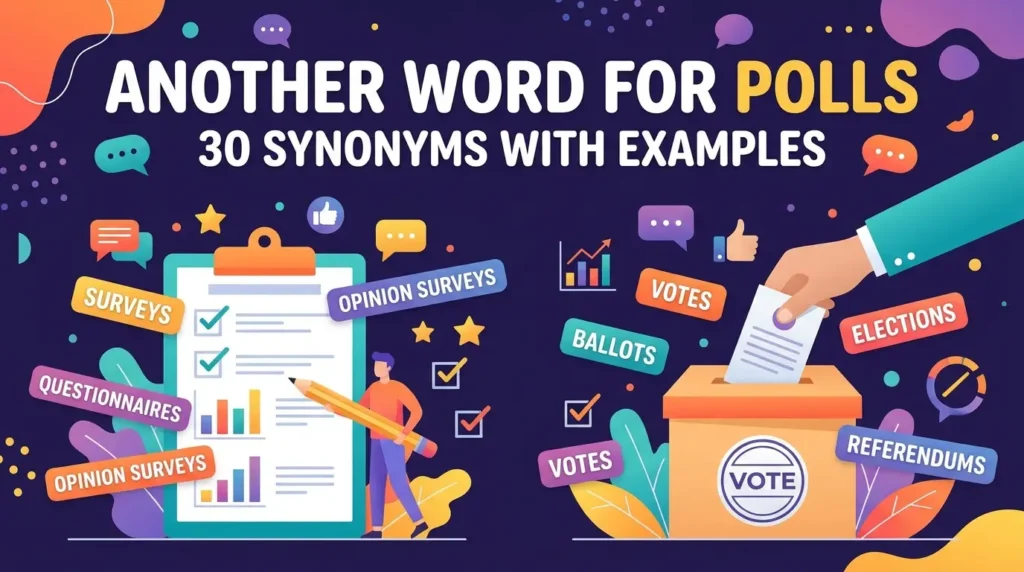
The best alternatives for polls include surveys, votes, ballots, elections, questionnaires, and opinion surveys. The right choice depends on what polls mean in your sentence.
Polls can refer to public opinion surveys, voting events, recorded votes, or the act of asking people questions. Each meaning has its own useful word choices. Some alternatives work in everyday speech, while others suit formal writing, politics, and research.
Quick list: Surveys, votes, ballots, elections, questionnaires, opinion surveys, voting, referendums, polls of opinion, and public consultations.
This guide explores 30 alternatives with simple meanings, IPA pronunciations, usage notes, and natural examples. It also explains word pairs, common phrases, and the differences between related terms.
At a Glance: Polls Synonyms and Related Alternatives
| Alternative | Part of Speech | Meaning | Register / Tone | Ideal Context |
| Surveys | Noun | Studies that collect people’s views | Neutral | General research |
| Votes | Noun | Choices made in an election | Neutral | Elections |
| Ballots | Noun | Votes or voting papers | Formal | Election processes |
| Opinion surveys | Noun | Studies of public views | Formal | Public opinion |
| Questionnaires | Noun | Sets of written questions | Neutral | Research |
| Elections | Noun | Events where people choose leaders | Formal | Politics |
| Referendums | Noun | Public votes on an issue | Formal | National decisions |
| Voting | Noun | The act of choosing by vote | Neutral | Election activity |
| Straw polls | Noun | Informal tests of opinion | Informal | Quick feedback |
| Poll results | Noun | Findings from a poll | Neutral | News and reports |
Which Word Should You Use?
| If you want to… | Use | Why |
| Ask people about their views | Survey | It covers a broad range of questions. |
| Find out public opinion | Opinion survey | It focuses on people’s views. |
| Collect answers in writing | Questionnaire | It means a set of questions. |
| Record a choice in an election | Vote | It refers to an individual choice. |
| Describe the voting process | Voting | It means taking part in an election. |
| Discuss a national public vote | Referendum | It lets people decide a public issue. |
| Test opinions informally | Straw poll | It gives a quick sense of views. |
| Discuss an official choice of leaders | Election | It means choosing people for public office. |
Exploring the Multiple Meanings of “Polls”
The word polls has several meanings. Its meaning changes with the topic and sentence.
1. Public Opinion Surveys
- Meaning: Polls can mean studies that ask people about their views.
- Explanation: Researchers ask selected people questions. They also use their answers to estimate wider public opinion.
- Example: Recent polls show that many people support the new plan.
2. Voting in Elections
- Meaning: Polls can refer to the act of voting in an election.
- Explanation: In this sense, the word relates to choosing leaders. It also refers to the wider voting process.
- Example: Thousands of people went to the polls on Sunday.
3. Places Where People Vote
- Meaning: Polls can mean places where voters cast their votes.
- Explanation: The phrase often refers to voting sites. However, people also use it when discussing election access.
- Example: The polls will close at seven o’clock tonight.
4. The Number or Total of Votes
- Meaning: A poll can refer to votes collected or counted.
- Explanation: This sense focuses on the number of votes. It also helps show how many people took part.
- Example: The final poll showed a record number of votes.
5. Election Results and Public Support
- Meaning: Polls can refer to reported results about candidates or parties.
- Explanation: News reports often use polls to show support levels. However, these figures do not always predict election results.
- Example: The latest polls put the leading party ahead.
Sources:
Collins English Dictionary+3
Analyzing 30 Polls Alternatives in Detail
Some alternatives are direct synonyms, while others fit specific voting or research contexts.
Group 1: Everyday Survey Alternatives
1. Surveys
IPA: US /ˈsɝːveɪz/ · UK /ˈsɜːveɪz/
Definition: Surveys collect information by asking people questions. They also help show common views and habits.
- Usage: This is the closest general alternative to opinion polls. However, surveys can cover more than public opinion.
- Example: The school conducted surveys to learn what students wanted.
2. Questionnaires
IPA: US and UK /ˌkwestʃəˈnerz/
Definition: Questionnaires contain questions for people to answer. They also help researchers collect views in a clear way.
- Usage: This is a related alternative, not an exact synonym. For example, a poll may use a questionnaire.
- Example: We completed questionnaires about the new school rules.
3. Opinion Surveys
IPA: US and UK /əˈpɪnjən ˈsɝːveɪz/
Definition: Opinion surveys ask people what they think. They also help show how views differ across groups.
- Usage: This is a close synonym for public opinion polls. However, it sounds more formal.
- Example: Opinion surveys showed strong support for better roads.
4. Public Opinion Surveys
IPA: US and UK /ˈpʌblɪk əˈpɪnjən ˈsɝːveɪz/
Definition: These surveys collect views from members of the public. They also help track changes in public mood.
- Usage: This is a formal alternative to political and social polls. It suits research and news reports.
- Example: Public opinion surveys revealed growing concern about prices.
5. Straw Polls
IPA: US and UK /ˈstrɔː poʊlz/ (UK /ˈstrɔː pəʊlz/)
Definition: Straw polls give a quick test of people’s views. They also offer an early sign of support.
- Usage: This is a close alternative for informal polls. However, it may not reflect the wider public.
- Example: Our office held straw polls before choosing a team leader.
Group 2: Voting and Election Alternatives
6. Votes
IPA: US and UK /voʊts/ (UK /vəʊts/)
Definition: Votes show the choices people make in an election. They also help decide who wins.
- Usage: This fits polls about voting or recorded choices. However, it does not mean an opinion survey.
- Example: The candidate received thousands of votes in the election.
7. Ballots
IPA: US and UK /ˈbælət̬s/ (UK /ˈbælɒts/)
Definition: Ballots are votes or papers used to record choices. They also help keep an election clear and fair.
- Usage: This is a close alternative when polls mean voting. In fact, ballots often refer to the voting method.
- Example: Voters placed their ballots into the sealed box.
8. Elections
IPA: US and UK /ɪˈlekʃənz/
Definition: Elections let people choose leaders or public officials. They also decide who will hold public office.
- Usage: This fits the phrase “the polls” in political contexts. However, an election is the event, not a survey.
- Example: The country will hold elections next spring.
9. Voting
IPA: US and UK /ˈvoʊtɪŋ/ (UK /ˈvəʊtɪŋ/)
Definition: Voting means making a choice in an election. It also allows people to take part in public decisions.
- Usage: This is a close alternative when polls mean the act of voting. Still, it does not mean a survey.
- Example: Voting began early at the local school.
10. Referendums
IPA: US /ˌrefəˈrendəmz/ · UK /ˌrefəˈrendəmz/
Definition: Referendums let people vote on a public issue. They also help decide major questions outside normal elections.
- Usage: This is a related alternative for polls about public decisions. However, a referendum is a formal public vote.
- Example: Citizens voted in a referendum on the new law.
11. Plebiscites
IPA: US /ˈplebɪˌsaɪts/ · UK /ˈplebɪsaɪts/
Definition: Plebiscites ask people to vote on an important issue. They also show public support for a proposed choice.
- Usage: This is a formal alternative to some public votes. However, its meaning can overlap with referendums.
- Example: The government called a plebiscite on the proposed change.
Group 3: Opinion Gathering and Public Feedback
12. Canvasses
IPA: US /ˈkænvəsɪz/ · UK /ˈkænvəsɪz/
Definition: Canvasses involve asking people about their views. They also help gather support or opinions.
- Usage: This is a related alternative to polls. For example, political groups canvass voters to learn their views.
- Example: The party organized canvasses across several local areas.
13. Interviews
IPA: US /ˈɪntərˌvjuːz/ · UK /ˈɪntəvjuːz/
Definition: Interviews involve asking people questions directly. They also give people room to explain their views.
- Usage: This is a related research method, not an exact synonym. However, pollsters may interview people during a poll.
- Example: The research team held interviews with local parents.
14. Consultations
IPA: US /ˌkɑːnsəlˈteɪʃənz/ · UK /ˌkɒnsəlˈteɪʃənz/
Definition: Consultations ask people for views before a decision. They also help groups understand public needs.
- Usage: This is a related alternative to public polls. Still, consultations often allow more detailed discussion.
- Example: The council began consultations about the new road plan.
15. Feedback
IPA: US and UK /ˈfiːdˌbæk/
Definition: Feedback means comments or views about something. It also helps people judge what others think.
- Usage: This is a related alternative, not a direct synonym. For example, a poll collects feedback from selected people.
- Example: The company asked customers for feedback on its new service.
16. Questioning
IPA: US and UK /ˈkwestʃənɪŋ/
Definition: Questioning means asking people for answers or views. It also helps gather facts about a subject.
- Usage: This is an action-based alternative, not a direct synonym for polls. However, questioning may form part of a poll.
- Example: The reporter began questioning voters outside the town hall.
Group 4: Poll Findings and Vote Counts
17. Poll Results
IPA: US /poʊl rɪˈzʌlts/ · UK /pəʊl rɪˈzʌlts/
Definition: Poll results show the answers gathered in a poll. They also reveal patterns in people’s views.
- Usage: This fits polls when you mean their findings. However, it does not mean the survey itself.
- Example: The poll results showed a rise in public support.
18. Tallies
IPA: US and UK /ˈtæliz/
Definition: Tallies are counts of votes or other items. They also help people track totals during an event.
- Usage: This is a close alternative when polls refer to vote counts. In fact, it suits election reports.
- Example: Officials checked the tallies before announcing the winner.
19. Counts
IPA: US and UK /kaʊnts/
Definition: Counts show the number of votes or people. They also give a clear total for a group.
- Usage: This is a related alternative to poll totals. However, a count does not show people’s wider opinions.
- Example: The final counts gave the winner a clear lead.
20. Returns
IPA: US /rɪˈtɝːnz/ · UK /rɪˈtɜːnz/
Definition: Returns are reports of votes or election results. They also show how candidates performed in an election.
- Usage: This is a formal election term, not a direct synonym for opinion polls. Still, it fits official vote reports.
- Example: Early returns showed the mayor leading the race.
21. Figures
IPA: US /ˈfɪɡjərz/ · UK /ˈfɪɡəz/
Definition: Figures are numbers that show results or totals. They also help explain changes in public support.
- Usage: This is a related alternative for poll data. However, figures alone do not mean polls.
- Example: The latest figures showed a drop in voter support.
Group 5: Specific Types of Polls
22. Exit Polls
IPA: US /ˈeɡzɪt poʊlz/ · UK /ˈeɡzɪt pəʊlz/
Definition: Exit polls ask voters about their choices after voting. They also give an early idea of election results.
- Usage: This is a specific type of election poll. For example, news teams report exit polls on voting day.
- Example: Exit polls suggested a close race between both parties.
23. Tracking Polls
IPA: US /ˈtrækɪŋ poʊlz/ · UK /ˈtrækɪŋ pəʊlz/
Definition: Tracking polls measure public views over time. They also show if support rises or falls.
- Usage: This is a specific type of opinion poll. However, it focuses on changes across repeated surveys.
- Example: Tracking polls showed the candidate gaining support each week.
24. Popularity Polls
IPA: US /ˌpɑːpjəˈlærəti poʊlz/ · UK /ˌpɒpjʊˈlærəti pəʊlz/
Definition: Popularity polls measure how much people like someone. They also help track public support for leaders.
- Usage: This is a close alternative for polls about public figures. Still, it focuses on approval or appeal.
- Example: Popularity polls showed the leader losing public support.
25. Approval Ratings
IPA: US /əˈpruːvəl ˈreɪtɪŋz/ · UK /əˈpruːvəl ˈreɪtɪŋz/
Definition: Approval ratings show how many people support a person or leader. They also help track changes in public trust.
- Usage: This is a related measure, not an exact synonym. For example, polls may produce approval ratings.
- Example: The president’s approval ratings fell after the new policy.
26. Opinion Polls
IPA: US /əˈpɪnjən poʊlz/ · UK /əˈpɪnjən pəʊlz/
Definition: Opinion polls ask people what they think about an issue. They also help show wider public views.
- Usage: This is an exact alternative when polls mean public opinion studies. In fact, the two terms often mean the same thing.
- Example: Opinion polls showed growing support for the plan.
Group 6: Wider Research and Public Choice Terms
27. Samples
IPA: US and UK /ˈsæmpəlz/
Definition: Samples are smaller groups chosen from a larger population. They also help researchers study wider views.
- Usage: This is a related research term, not an exact synonym. However, polls often use samples of people.
- Example: Researchers chose samples from several towns across the country.
28. Census Surveys
IPA: US and UK /ˈsensəs ˈsɝːveɪz/
Definition: Census surveys collect information about a whole population. They also help show facts about people and households.
- Usage: This is a related research term, not an exact synonym. Unlike most polls, a census aims to cover everyone.
- Example: Census surveys help the state plan schools and hospitals.
29. Show of Hands
IPA: US /ʃoʊ əv hændz/ · UK /ʃəʊ əv hændz/
Definition: A show of hands lets people express a choice by raising their hands. It also gives a quick group result.
- Usage: This is a related alternative for informal voting polls. However, it does not offer the same privacy as a secret ballot.
- Example: The teacher used a show of hands to pick the topic.
30. Public Consultations
IPA: US /ˈpʌblɪk ˌkɑːnsəlˈteɪʃənz/ · UK /ˈpʌblɪk ˌkɒnsəlˈteɪʃənz/
Definition: Public consultations invite people to share views on public plans. They also help leaders hear concerns before making choices.
- Usage: This is a related alternative, not an exact synonym. Still, it suits polls about public policy and local plans.
- Example: Public consultations helped shape the town’s new transport plan.
Sources:
Collins English Dictionary+4
Polls vs. Surveys vs. Elections: What’s the Difference?
The words polls, surveys, and elections have related meanings. However, they do not always mean the same thing.
| Word | Main Meaning | Key Difference |
| Polls | Opinion studies or voting activity | Often focus on public views or votes |
| Surveys | Studies that collect information | Cover many topics beyond opinions |
| Elections | Events where people choose leaders | Involve official choices for public office |
| Questionnaires | Sets of questions | Collect answers in written form |
| Referendums | Public votes on an issue | Let voters decide a specific question |
| Ballots | Votes or voting papers | Record individual choices |
When should you use each word?
- Use polls when discussing public opinion or election voting.
- Choose surveys for wider research and information gathering.
- Use elections when people choose public leaders.
- Choose referendums when voters decide a major public issue.
- Use questionnaires when people answer a set of questions.
In short, these words share some uses. However, their meanings depend on the type of activity.
Sources:
Collins English Dictionary+3
Polls and Opposite/Paired Word Pairs
The word polls has no single direct opposite. However, several words show natural contrasts or related ideas.
| Word | Paired Word | Note |
| Polls | Results | Polls collect views, while results show findings. |
| Majority | Minority | These show larger and smaller groups. |
| Yes | No | These express opposite answers. |
| Support | Opposition | These show agreement and disagreement. |
| Public | Private | These show different levels of access. |
| Voter | Non-voter | These distinguish people who vote and those who do not. |
| Election | Appointment | These show two ways to choose someone. |
| Opinion | Fact | These distinguish personal views from proven information. |
| Sample | Population | A sample represents part of a wider group. |
| Approval | Disapproval | These show positive and negative views. |
These pairs help explain poll findings and voting choices. For example, majority and minority often appear in reports about public opinion.
Sources:
Collins English Dictionary+2
Common Word Partners of “Polls”
Polls often appear with words about public opinion, elections, results, and support. These common word partners make writing more natural.
| Pattern | Common Partners | Example |
| Opinion + poll | Public, national, political | The national opinion poll showed strong support. |
| Type + poll | Exit, straw, tracking | The exit poll predicted a close race. |
| Time + poll | Recent, latest, weekly | Recent polls show a change in public views. |
| Poll + verb | Shows, reveals, suggests | The poll suggests growing support. |
| Verb + poll | Conduct, hold, publish | Researchers will conduct a poll next week. |
| Poll + noun | Results, figures, data | The poll results surprised the team. |
| Poll + preposition | On, about, among | The poll asked voters about education. |
| Poll + adjective | Online, telephone, national | The online poll received many responses. |
| Poll + result phrase | Lead, support, approval | The latest polls show a narrow lead. |
| Poll + action | Release, report, analyze | The group will release its poll tomorrow. |
These word partners help readers understand what a poll measures. They also make reports easier to read.
Sources:
Collins English Dictionary+3
Idiomatic Phrases Featuring “Polls”
The word polls appears in several common political expressions. Some are fixed phrases rather than true idioms.
1. Go to the Polls
- Meaning: To take part in an election by voting.
- Example: Millions of citizens will go to the polls tomorrow.
2. At the Polls
- Meaning: At an election or during the voting process.
- Example: The party hopes to win more seats at the polls.
3. Ahead in the Polls
- Meaning: Receiving more public support than other candidates.
- Example: The young candidate remains ahead in the polls.
4. Behind in the Polls
- Meaning: Receiving less public support than another candidate.
- Example: The party fell behind in the polls last month.
Sources:
Collins English Dictionary+2
Word Formation of “Polls”
Etymology & Structure
Polls is the plural form of the noun poll. The word also works as the third-person singular form of the verb poll.
The word poll came from Middle Low German or Middle Dutch. It first referred to the head or top of a person’s head.
Later, people used it to mean a person or an individual. The voting sense grew from counting people one by one.
Date and History
The noun poll appeared in English around 1300. Its voting sense dates to the 1620s.
The verb poll also appeared in the 1620s. The meaning of a public opinion survey appeared around 1902.
These dates show how the word gained new meanings over time.
Word Class Variations
| Word Form | Part of Speech | Meaning |
| Poll | Noun | One survey or voting event |
| Polls | Plural noun | More than one poll |
| Poll | Verb | To ask for opinions or count votes |
| Polls | Verb | Asks for opinions or records votes |
| Polled | Past tense | Asked people or recorded votes |
| Polling | Present participle / noun | Asking people or taking votes |
| Pollster | Noun | A person who conducts opinion polls |
| Polling | Adjective | Related to voting or opinion surveys |
Sources:
Collins English Dictionary+3
Common Word Choice Mistakes
Here are seven common mistakes involving polls and related words.
1. Wrong: The survey was held to elect a president.
Correction: The election was held to elect a president.
2. Wrong: The referendum asked people about their favorite food.
Correction: The opinion poll asked people about their favorite food.
3. Wrong: The questionnaire showed that the candidate won the election.
Correction: The election results showed that the candidate won.
4. Wrong: The poll received 500 votes from customers.
Correction: The poll received 500 responses from customers.
5. Wrong: The survey paper was counted as the winner.
Correction: The ballot was counted as a vote.
6. Wrong: The census asked only a small group for opinions.
Correction: The poll asked a small group for opinions.
7. Wrong: The approval rating asked voters to choose a leader.
Correction: The election asked voters to choose a leader.
These corrections help separate surveys, voting methods, and election results.
Frequently Asked Questions
1. What is the closest synonym for polls?
Surveys are the closest general synonym when polls mean studies of public opinion. However, votes may fit election contexts.
2. What is another word for public opinion polls?
You can use opinion surveys or public opinion surveys. Both refer to studies that collect people’s views.
3. What is a formal alternative to polls?
Public opinion surveys sound more formal. They suit research papers, reports, and news articles.
4. What is an informal word for polls?
Straw polls are informal tests of people’s opinions. They often give a quick idea of group support.
5. Are polls and surveys the same?
They have similar meanings, but they are not always equal. Surveys cover more topics than public opinion polls.
6. What is another word for election polls?
You can use voting results or election surveys. However, these terms refer to different parts of the election process.
7. What is the opposite of polls?
Polls have no direct opposite. However, words like opposition and disapproval express contrasting views in poll results.
8. What does “go to the polls” mean?
It means taking part in an election by voting. People often use this phrase on election day.
9. Can polls refer to voting places?
Yes. The phrase “the polls” can mean places where people cast their votes.
10. What is the difference between polls and ballots?
Polls can mean surveys or voting activity. Ballots are votes or papers that record people’s choices.
Sources:
Collins English Dictionary+5
Conclusion
The best alternatives for polls include surveys, votes, ballots, opinion surveys, and elections. Each word has a different use.
However, context matters when choosing the right alternative. Some words relate to public opinion, while others refer to voting or election results.
Choose surveys for general research and opinion surveys for public views. Use votes, ballots, or elections when discussing the voting process. The right word makes your writing clear and accurate.

Sikandar Hayat is the author of PublivoHub.com, a platform dedicated to synonyms, alternative words, and vocabulary improvement. He aims to help readers find the right words and express their ideas more clearly and effectively. Through simple explanations and useful word alternatives, Sikandar makes it easier for students, writers, bloggers, and everyday readers to improve their writing and expand their vocabulary.