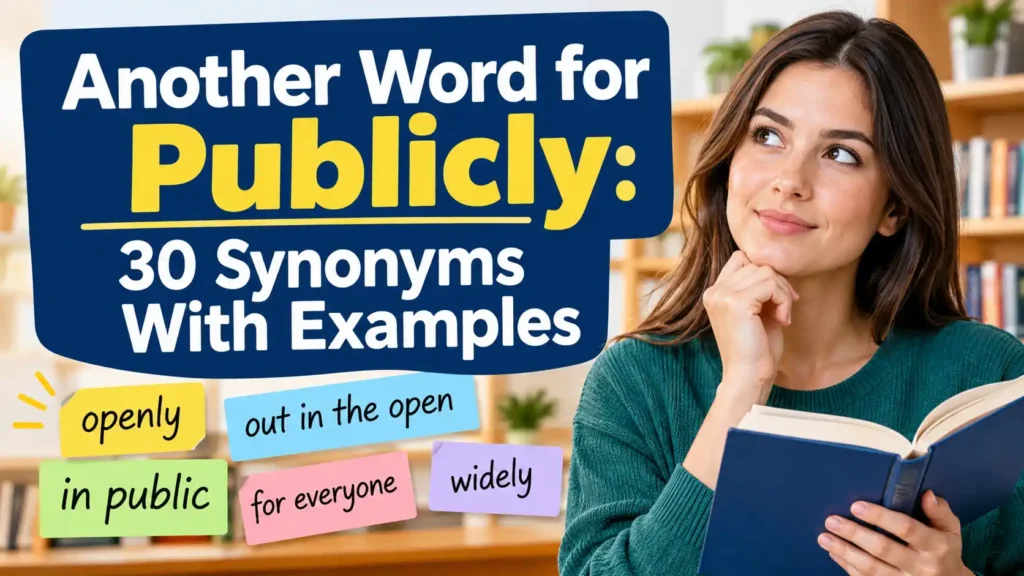
Another word for publicly is openly. Other common alternatives include in public, transparently, overtly, frankly, and openly before others. These words suggest that people can see, hear, or know something.
However, the best choice depends on context. Publicly can refer to open actions, public statements, government funding, public ownership, or decisions involving ordinary people.
Quick list: Openly, in public, overtly, transparently, frankly, candidly, officially, formally, visibly, and before an audience.
This guide explores 30 alternatives with meanings, IPA, usage notes, and examples. It also explains their differences and shows when each word works best.
At a Glance: Publicly Synonyms and Related Alternatives
| Alternative | Part of Speech | Meaning | Register / Tone | Ideal Context |
| Openly | Adverb | Without hiding anything | Everyday | Open actions |
| In public | Adverb phrase | Where people can see | Everyday | Public events |
| Overtly | Adverb | In a clear and direct way | Formal | Clear actions |
| Transparently | Adverb | Honestly and openly | Formal | Business and decisions |
| Frankly | Adverb | In an honest way | Everyday | Honest opinions |
| Candidly | Adverb | Without hiding thoughts | Formal | Honest discussions |
| Officially | Adverb | Through an approved act | Formal | Public statements |
| Formally | Adverb | In a proper official way | Formal | Public events |
| Visibly | Adverb | In a way people can see | Neutral | Visible reactions |
| Collectively | Adverb | As a group | Neutral | Group decisions |
Which Word Should You Use?
| If you want to… | Use | Why |
| Show something without hiding it | Openly | It suggests honesty and openness. |
| Talk about an event before people | In public | It focuses on the place or audience. |
| Make an action clear | Overtly | It highlights visible or clear conduct. |
| Show honest business practices | Transparently | It suggests clear and honest actions. |
| Share an honest opinion | Frankly | It suits direct personal views. |
| Make an official statement | Officially | It shows formal approval or authority. |
| Speak before a group | Before an audience | It focuses on the listeners. |
| Show something everyone can see | In full view | It highlights visibility. |
Exploring the Multiple Meanings of “Publicly”
The word publicly has several related meanings. Its exact meaning depends on the action and context.
1. In an open and visible way
- Meaning: Something happens where other people can see or hear it.
- Explanation: This sense contrasts with private or secret actions. For example, people may speak or argue publicly.
- Example: She publicly thanked her team during the award ceremony.
2. Without hiding thoughts or opinions
- Meaning: Someone shares their views openly with others.
- Explanation: This sense often involves honesty or direct speech. It also suggests that someone does not hide their position.
- Example: The mayor publicly opposed the new plan.
3. Through an official public statement
- Meaning: Someone makes an announcement or statement for everyone to hear.
- Explanation: This sense often involves leaders, companies, or public figures. It also covers formal apologies and announcements.
- Example: The company publicly announced its new business plans.
4. Through government action or support
- Meaning: The government or a public body provides something.
- Explanation: This sense appears in funding, services, and public projects. It also refers to money from public funds.
- Example: The government publicly funded the new school.
5. Through public ownership or participation
- Meaning: Something belongs to or involves the general public.
- Explanation: This sense appears in business and finance. It also refers to companies with shares available to public investors.
- Example: The company is publicly traded on the stock market.
Analyzing 30 Public Alternatives in Detail
Some alternatives are direct synonyms of publicly. Others work only in certain settings or meanings.
Core Everyday Synonyms
1. Openly
IPA: US /ˈoʊ.pən.li/ · UK /ˈəʊ.pən.li/
Definition: Openly means doing something without hiding it. It also suggests honesty and clear communication.
- Usage: This is the closest everyday alternative to publicly. However, it can refer to honesty without a public audience.
- Example: She openly shared her concerns about the new school rules.
2. In public
IPA: US /ɪn ˈpʌb.lɪk/ · UK /ɪn ˈpʌb.lɪk/
Definition: In public means doing something where other people can see or hear. It also contrasts with private settings.
- Usage: This is a direct alternative when publicly refers to a place or audience. However, it does not always suggest openness.
- Example: He never talks about family problems in public.
3. Overtly
IPA: US /oʊˈvɝːt.li/ · UK /əʊˈvɜːt.li/
Definition: Overtly means doing something in a clear and noticeable way. It also suggests that someone does not hide their actions.
- Usage: This is a formal choice for visible actions. However, it does not always mean before an audience.
- Example: The manager overtly supported the workers during the meeting.
4. Plainly
IPA: US /ˈpleɪn.li/ · UK /ˈpleɪn.li/
Definition: Plainly means in a clear and easy-to-see way. It also suggests simple and direct speech.
- Usage: This works when publicly means clearly or openly. However, it can refer to clear facts rather than public events.
- Example: The leader plainly explained why the project had failed.
5. Visibly
IPA: US /ˈvɪz.ə.bli/ · UK /ˈvɪz.ə.bli/
Definition: Visibly means in a way that people can see. It also refers to clear signs of change or emotion.
- Usage: This is a related choice when something happens openly. However, it focuses on sight rather than public knowledge.
- Example: The coach was visibly upset after the team’s loss.
Honest and Direct Communication
6. Frankly
IPA: US /ˈfræŋk.li/ · UK /ˈfræŋk.li/
Definition: Frankly means speaking in an honest and direct way. It also shows that someone shares their real thoughts.
- Usage: This works for honest opinions shared publicly. However, it does not mean speaking before a crowd.
- Example: The teacher frankly discussed the problems with the new plan.
7. Candidly
IPA: US /ˈkæn.dɪd.li/ · UK /ˈkæn.dɪd.li/
Definition: Candidly means speaking honestly without hiding important thoughts. It also suggests a direct and open approach.
- Usage: This suits honest talks and public comments. However, it sounds more formal than open.
- Example: The director candidly answered questions about the company’s future.
8. Forthrightly
IPA: US /ˈfɔːrθ.raɪt.li/ · UK /ˈfɔːθ.raɪt.li/
Definition: Forthrightly means speaking in a clear and honest way. It also suggests courage and directness.
- Usage: This is a formal alternative for open statements. However, it focuses on direct speech rather than audience size.
- Example: The senator forthrightly explained her views during the debate.
9. Aboveboard
IPA: US /əˌbʌvˈbɔːrd/ · UK /əˌbʌvˈbɔːd/
Definition: Aboveboard means honest and free from hidden plans. It also suggests fair conduct.
- Usage: This is a related alternative for honest public actions. However, it does not directly mean in front of people.
- Example: The company kept its business dealings aboveboard.
10. Transparently
IPA: US /trænsˈper.ənt.li/ · UK /trænsˈpær.ənt.li/
Definition: Transparently means acting in an open and clear way. It also suggests that people can understand what happens.
- Usage: This suits public decisions and business practices. For example, leaders may act transparently when sharing records.
- Example: The council transparently explained how it spent public money.
Visible and Open Actions
11. Without concealment
IPA: US /wɪˈðaʊt kənˈsiːl.mənt/ · UK /wɪˈðaʊt kənˈsiːl.mənt/
Definition: Without concealment means doing something without trying to hide it. It also suggests openness.
- Usage: This is a close phrase for publicly in secret-related contexts. However, it sounds more formal.
- Example: The group shared its plans without concealment.
12. Without secrecy
IPA: US /wɪˈðaʊt ˈsiː.krə.si/ · UK /wɪˈðaʊt ˈsiː.krə.si/
Definition: Without secrecy means allowing others to know what happens. It also suggests clear communication.
- Usage: This fits public talks and open decisions. However, it does not always mean speaking before an audience.
- Example: The board discussed its plans without secrecy.
13. In the open
IPA: US /ɪn ði ˈoʊ.pən/ · UK /ɪn ði ˈəʊ.pən/
Definition: In the open means where people can see or know something. It also suggests a lack of secrecy.
- Usage: This informal phrase works for open actions. However, it can refer to plans or facts rather than speech.
- Example: The team brought its concerns out in the open.
14. In full view
IPA: US /ɪn fʊl ˈvjuː/ · UK /ɪn fʊl ˈvjuː/
Definition: In full view means where everyone present can see something. It also highlights clear visibility.
- Usage: This is a related phrase for visible public actions. However, it focuses on sight rather than public approval.
- Example: The artist painted the large wall in full view.
15. For all to see
IPA: US /fɔːr ɔːl tə ˈsiː/ · UK /fɔː ɔːl tə ˈsiː/
Definition: For all to see means something is open for everyone to view. It also stresses clear visibility.
- Usage: This phrase suits public displays and open actions. However, it can sound dramatic.
- Example: The school displayed the winning design for all to see.
Official and Formal Communication
16. Officially
IPA: US /əˈfɪʃ.əl.i/ · UK /əˈfɪʃ.əl.i/
Definition: Officially means through an accepted or approved act. It also refers to statements from people with authority.
- Usage: This works when publicly refers to an official announcement. However, an official action may happen privately.
- Example: The mayor officially opened the new sports center.
17. Formally
IPA: US /ˈfɔːr.mə.li/ · UK /ˈfɔː.mə.li/
Definition: Formally means following proper rules or accepted steps. It also suggests a serious tone.
- Usage: This fits formal statements and public events. However, it does not always mean open to everyone.
- Example: The school formally announced the changes to its staff.
18. On the record
IPA: US /ɑːn ðə ˈrek.ɚd/ · UK /ɒn ðə ˈrek.ɔːd/
Definition: On the record means something can be officially reported or quoted. It also suggests that a speaker accepts responsibility.
- Usage: This is a related phrase for public statements. However, it does not mean every person can hear the statement.
- Example: The manager discussed the issue on the record.
19. To the public
IPA: US /tə ðə ˈpʌb.lɪk/ · UK /tə ðə ˈpʌb.lɪk/
Definition: To the public means directed toward ordinary people. It also shows that information reaches a wide audience.
- Usage: This fits announcements and shared information. However, it focuses on the audience rather than the manner.
- Example: The company released its new safety rules to the public.
20. Before an audience
IPA: US /bɪˈfɔːr ən ˈɔː.di.əns/ · UK /bɪˈfɔːr ən ˈɔː.di.əns/
Definition: Before an audience means in front of people who watch or listen. It also suggests a public setting.
- Usage: This is a context-specific alternative for public speaking. However, it requires an audience.
- Example: She shared her research before an audience of students.
Wide Reach and Public Attention
21. Widely
IPA: US /ˈwaɪd.li/ · UK /ˈwaɪd.li/
Definition: Widely means among many people or across a large area. It also suggests broad reach.
- Usage: This is a related choice when publicly refers to wide attention. However, it does not always mean openly.
- Example: The news was widely shared across social media.
22. Broadly
IPA: US /ˈbrɔːd.li/ · UK /ˈbrɔːd.li/
Definition: Broadly means across a wide group or range. It also suggests general coverage.
- Usage: This fits statements that reach many people. However, it does not mean an action happens in public.
- Example: The proposal was broadly discussed among local residents.
23. Generally
IPA: US /ˈdʒen.ər.əl.i/ · UK /ˈdʒen.rəl.i/
Definition: Generally means in most cases or among people as a whole. It also suggests a broad view.
- Usage: This is a related alternative for general public matters. However, it does not mean openly or visibly.
- Example: The new rules were generally accepted by local residents.
24. In the public eye
IPA: US /ɪn ðə ˈpʌb.lɪk aɪ/ · UK /ɪn ðə ˈpʌb.lɪk aɪ/
Definition: In the public eye means receiving attention from many people. It also suggests public interest.
- Usage: This phrase suits famous people and public figures. However, it refers to attention rather than a single open act.
- Example: The actor has lived in the public eye for years.
Government and Public Participation
25. Collectively
IPA: US /kəˈlek.tɪv.li/ · UK /kəˈlek.tɪv.li/
Definition: Collectively means acting together as a group. It also refers to shared action or choice.
- Usage: This is a related alternative when the public acts as a group. However, it does not mean openly.
- Example: Residents collectively agreed to improve the local park.
26. By the public
IPA: US /baɪ ðə ˈpʌb.lɪk/ · UK /baɪ ðə ˈpʌb.lɪk/
Definition: By the public means done or supported by ordinary people. It also suggests public involvement.
- Usage: This fits actions taken by people as a group. However, it differs from actions simply seen by people.
- Example: The local project was funded by the public.
27. Through public funds
IPA: US /θruː ˈpʌb.lɪk fʌndz/ · UK /θruː ˈpʌb.lɪk fʌndz/
Definition: Through public funds means using money collected or held for public use. It also points to government support.
- Usage: This is a related phrase for publicly funded projects. However, it is not replaced publicly in every sentence.
- Example: The new library was built through public funds.
28. With public consent
IPA: US /wɪð ˈpʌb.lɪk kənˈsent/ · UK /wɪð ˈpʌb.lɪk kənˈsent/
Definition: With public consent means having approval from the people. It also suggests shared agreement.
- Usage: This suits decisions that need public support. However, consent is not the same as public visibility.
- Example: The plan moved forward with public consent.
29. Under public ownership
IPA: US /ˈʌn.dɚ ˈpʌb.lɪk ˈoʊ.nɚ.ʃɪp/ · UK /ˈʌn.də ˈpʌb.lɪk ˈəʊ.nə.ʃɪp/
Definition: Under public ownership means owned by the government or a public body. It also suggests shared public control.
- Usage: This relates to publicly owned services and companies. However, it refers to ownership rather than open communication.
- Example: The railway remained under public ownership for many years.
30. On a public basis
IPA: US /ɑːn ə ˈpʌb.lɪk ˈbeɪ.sɪs/ · UK /ɒn ə ˈpʌb.lɪk ˈbeɪ.sɪs/
Definition: On a public basis means according to public rules or access. It also suggests an arrangement involving the community.
- Usage: This is a context-specific phrase, not a direct synonym. Use it when discussing public access or services.
- Example: The town offered the service on a public basis.
Publicly vs. Openly vs. In Public
These three expressions often appear in similar sentences. However, they do not always carry the same meaning.
| Word or Phrase | Main Focus | Example |
| Publicly | Open access or public knowledge | She publicly apologized. |
| Openly | Honesty and lack of secrecy | She openly admitted her mistake. |
| In public | A place where others can see | She apologized in public. |
When should you choose each one?
- Use publicly when information or actions reach the general public.
- Choose openly when someone shares thoughts without hiding them.
- Use in public when the setting or audience matters most.
For example, a person can speak openly during a private meeting. However, that does not mean they spoke publicly.
Publicly and Opposite/Paired Word Pairs
Publicly often contrasts with words about privacy and secrecy. Some related pairs also show how public actions work.
| Word | Paired Word | Note |
| Publicly | Privately | Open versus private |
| Openly | Secretly | Without hiding versus hidden |
| Publicly | Covertly | Open versus concealed |
| Publicly | Privately funded | Public versus private funding |
| Publicly | Individually | Group or public action versus personal action |
| Publicly | Confidentially | Open information versus protected information |
| Publicly | In camera | Open proceedings versus closed proceedings |
| Publicly | Behind closed doors | Public view versus private discussion |
These pairs do not all work as exact grammatical opposites. Still, they help readers understand the main differences.
Common Word Partners of “Publicly”
Public often appears before verbs and adjectives. These word pairs help readers use it naturally.
| Pattern | Common Partners | Example |
| Publicly + announce | Announce, declare | The school publicly announced its new rules. |
| Publicly + apologize | Apologize, admit | The player publicly apologized for his actions. |
| Publicly + support | Support, oppose | She publicly supported the new policy. |
| Publicly + criticize | Criticize, challenge | Workers publicly criticized the decision. |
| Publicly + acknowledge | Acknowledge, recognize | The company publicly acknowledged its mistake. |
| Publicly + available | Available, accessible | The report is publicly available online. |
| Publicly + funded | Funded, financed | The project is publicly funded. |
| Publicly + owned | Owned, controlled | The service is publicly owned. |
| Publicly + traded | Traded, listed | The company is publicly traded. |
| Publicly + disclose | Disclose, reveal | The group publicly disclosed its findings. |
These patterns cover communication, business, government, and public access. Therefore, choose a partner that matches your intended meaning.
Idiomatic Phrases Featuring “Publicly”
Publicly has few fixed idioms of its own. However, several established phrases carry similar meanings.
1. In the public eye
- Meaning: Receiving attention or interest from the general public.
- Example: The singer has remained in the public eye for decades.
2. Out in the open
- Meaning: No longer hidden or kept secret.
- Example: The truth finally came out in the open.
3. On the record
- Meaning: Something a person allows others to report or quote.
- Example: The officer shared his views on the record.
4. For all to see
- Meaning: Something that everyone can view or notice.
- Example: The artist displayed her work for all to see.
These expressions can be replaced publicly in certain contexts. However, each has its own meaning and use.
Word Formation of “Publicly”
Etymology and Structure
Publicly comes from the adjective public and the suffix -ly.
The suffix -ly turns many adjectives into adverbs. Therefore, publicly means in a public manner or through public action.
The word public comes from Latin publicus. It relates to people and the affairs of a community.
Date and History
Etymonline traces publicly to the 1560s. Its early meaning referred to something happening in public.
The word later gained a sense linked to public action and community affairs.
The spelling publically also appeared in English. However, publicly remains the standard spelling.
Word Class Variations
| Word | Part of Speech | Meaning |
| Public | Adjective / Noun | Open to people or the general population |
| Publicly | Adverb | In an open or public way |
| Publicity | Noun | Attention from the public |
| Publicist | Noun | Someone who gains public attention for a person or group |
| Publicize | Verb | To make something known to people |
| Publicized | Verb / Adjective | Made known to the public |
| Publicizing | Verb | Making information known |
| Publicness | Noun | The state of being public |
Common Word-Choice Mistakes
Here are seven common mistakes involving publicly and similar words.
1. Wrong: She spoke publicly during a private call.
Better: She spoke openly during a private call.
2. Wrong: The company publicly funded the project with private money.
Better: The company privately funded the project.
3. Wrong: He publicly announced the news to himself.
Better: He privately shared the news with himself.
4. Wrong: She openly spoke at a private event.
Better: She spoke openly at the event.
5. Wrong: The company was publicly owned by one person.
Better: The company was privately owned by one person.
6. Wrong: The manager officially spoke without approval.
Better: The manager spoke publicly without official approval.
7. Wrong: The report was widely available to nobody.
Better: The report was not publicly available.
Frequently Asked Questions
1. What is the closest synonym for publicly?
Openly is the closest everyday synonym. It suggests sharing information or taking action without hiding anything.
2. What is another simple word for publicly?
Use openly or in public. Both work in many everyday sentences.
3. What is a formal alternative to publicly?
Overtly and transparently are useful formal choices. However, each has a different focus.
4. What is a professional alternative to publicly?
Officially works for approved announcements. Transparently suits honest business decisions and clear communication.
5. What is the opposite of publicly?
Privately is the most common opposite. Secretly and covertly also work in certain contexts.
6. Is publicly the same as openly?
Not always. Publicly focuses on public access or knowledge, while openly focuses on honesty.
7. Can publicly mean officially?
Sometimes. However, officially suggests approval or authority, while publicly suggests public knowledge or access.
8. Can publicly describe government funding?
Yes. Publicly funded means the government or another public body provides the money.
9. Is publicly or publically correct?
Publicly is the standard spelling in modern English. Publically exists as a less common spelling.
10. Is publicly an adverb?
Yes. Publicly is an adverb formed from the adjective public and the suffix -ly.
Conclusion
The closest everyday alternatives to publicly include openly, in public, overtly, and transparently. Each offers a slightly different meaning.
However, context matters when choosing the right word. Officially suits approved statements, while frankly suits honest opinions.
For the clearest writing, consider your audience and intended meaning. Choose the alternative that expresses your message naturally and accurately.

Sikandar Hayat is the author of PublivoHub.com, a platform dedicated to synonyms, alternative words, and vocabulary improvement. He aims to help readers find the right words and express their ideas more clearly and effectively. Through simple explanations and useful word alternatives, Sikandar makes it easier for students, writers, bloggers, and everyday readers to improve their writing and expand their vocabulary.