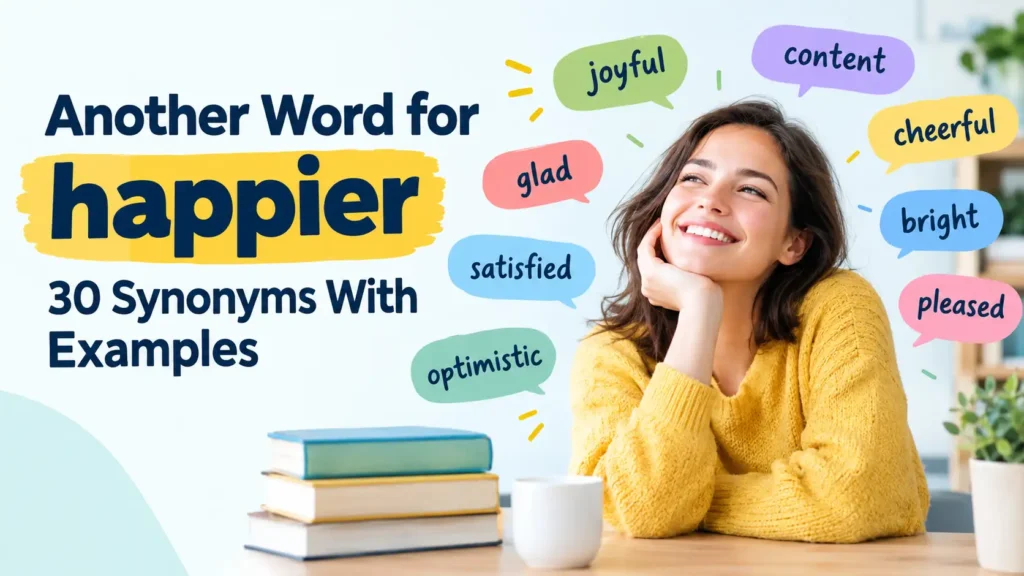
Another word for happier is more joyful, more cheerful, more pleased, or more content. The best choice depends on why someone feels good and how strong that feeling is. For example, more delighted shows stronger joy, while more content suggests greater peace with life.
You can also use words like more satisfied, more upbeat, more elated, or more overjoyed. However, these choices do not mean exactly the same thing. Some show a calm sense of joy, while others express excitement or relief.
Quick list:
- More joyful
- More cheerful
- More pleased
- More content
- More delighted
- More satisfied
- More upbeat
- More elated
- More thrilled
- More overjoyed
This guide explores 30 alternatives with meanings, pronunciations, usage notes, and examples. It also explains common word pairs, useful phrases, and mistakes to avoid.
At a Glance: Happier Synonyms and Related Alternatives
| Alternative | Part of Speech | Meaning | Register / Tone | Ideal Context |
| More joyful | Adjective phrase | Feeling more joy | Neutral | Personal happiness |
| More cheerful | Adjective phrase | Showing more good spirits | Neutral | Mood and behavior |
| More pleased | Adjective phrase | Feeling greater approval or pleasure | Neutral | Good news or results |
| More content | Adjective phrase | Feeling more at peace | Neutral | Life and daily needs |
| More delighted | Adjective phrase | Feeling much greater pleasure | Neutral | Welcome news |
| More satisfied | Adjective phrase | Feeling that needs are better met | Neutral | Work and goals |
| More elated | Adjective phrase | Feeling much more excited and happy | Formal | Great success |
| More thrilled | Adjective phrase | Feeling more joy and excitement | Informal | Special events |
| More upbeat | Adjective phrase | Feeling or seeming more positive | Informal | Mood and outlook |
| More overjoyed | Adjective phrase | Feeling far greater joy | Strong emotion | Wonderful news |
Which Word Should You Use?
| If you want to… | Use | Why |
| Show greater joy | More joyful | It puts the focus on joy. |
| Describe a brighter mood | More cheerful | It suggests a happier mood or manner. |
| Show pleasure about news | More pleased | It fits a clear reason for happiness. |
| Describe greater peace with life | More content | It suggests calm satisfaction. |
| Express strong happiness | More delighted | It shows a high level of pleasure. |
| Show that a goal feels worthwhile | More satisfied | It focuses on needs, results, or wishes. |
| Describe great excitement after success | More elated | It suggests a strong rise in mood. |
| Show greater hope or positivity | More upbeat | It highlights a positive outlook. |
Exploring the Multiple Meanings of “Happier”
The word happier is the comparative form of happy. It compares two people, moods, times, or states of well-being.
1. Feeling Greater Joy
- Meaning: Feeling more pleasure or joy than before or than someone else.
- Explanation: This is the most common sense of happier. Words like more joyful and more delighted can express this feeling.
- Example: Maya felt happier after spending the afternoon with her friends.
2. Feeling More Content With Life
- Meaning: Feeling more at ease with life and its current state.
- Explanation: This sense focuses on peace rather than excitement. The phrase more content often fits this meaning.
- Example: He felt happier after finding a job that suited his needs.
3. Showing a Brighter Mood
- Meaning: Seeming more cheerful or positive in daily life.
- Explanation: A person may look happier through their words, actions, or facial expressions. However, outward signs do not always reveal someone’s true feelings.
- Example: Her team noticed she seemed happier after joining the club.
4. Feeling Greater Pleasure About Something
- Meaning: Feeling more pleased with a choice, event, or result.
- Explanation: This sense links happiness to a clear cause. For example, more pleased often fits news, plans, or work.
- Example: I was happier with the second design than the first.
5. Feeling More Willing to Do Something
- Meaning: Being more ready or willing to take action.
- Explanation: In phrases like happier to help, the word can show greater willingness. It does not always mean stronger joy.
- Example: She was happier to work from home than commute daily.
Analyzing 30 Happier Alternatives in Detail
Some choices below are direct synonyms in certain contexts. Others express a related feeling, so the best choice depends on your sentence.
Core Words for Greater Happiness
1. More joyful
IPA: joyful /ˈdʒɔɪfəl/ (US and UK)
Definition: Feeling more joy or showing greater delight. It also suggests a strong sense of happiness.
- Usage: This is a close alternative to happier. However, it can sound more heartfelt or expressive.
- Example: The children felt more joyful during the family reunion.
2. More cheerful
IPA: cheerful /ˈtʃɪrfəl/ (US) · /ˈtʃɪəfəl/ (UK)
Definition: Showing a brighter mood and more good spirits. It also suggests a friendly, happy manner.
- Usage: This word fits mood and behavior. In fact, it often focuses on how someone seems.
- Example: Liam became more cheerful after talking with his best friend.
3. More pleased
IPA: pleased /pliːzd/ (US and UK)
Definition: Feeling greater pleasure or approval. It also fits a good result or welcome event.
- Usage: This choice works well when something causes happiness. However, it may sound less emotional than overjoyed.
- Example: Nina felt more pleased with her final test score.
4. More content
IPA: content /kənˈtent/ (US and UK)
Definition: Feeling more at ease with what you have. It also suggests that you want little more.
- Usage: Use this word for calm happiness. Unlike thrilled, it does not suggest strong excitement.
- Example: He felt more content after moving to a quiet town.
5. More glad
IPA: glad /ɡlæd/ (US and UK)
Definition: Feeling greater pleasure or relief. It also often links happiness to a clear event.
- Usage: This is a natural choice in everyday speech. For example, people often say they are glad about good news.
- Example: I was more glad to see my cousins than I expected.
Words for Strong Joy and Excitement
6. More delighted
IPA: delighted /dɪˈlaɪtɪd/ (US and UK)
Definition: Feeling much greater pleasure. It also suggests a strong, warm response to something good.
- Usage: This word suits happy news or a pleasant surprise. However, it can sound more formal than thrilled.
- Example: She felt more delighted after hearing that her friend was coming.
7. More elated
IPA: elated /ɪˈleɪtɪd/ (US and UK)
Definition: Feeling much happier and more excited. It also often follows success or a major win.
- Usage: This word is stronger and more formal than glad. In fact, it often suggests a sudden lift in mood.
- Example: The players felt more elated after winning the final match.
8. More thrilled
IPA: thrilled /θrɪld/ (US and UK)
Definition: Feeling more joy mixed with excitement. It also suits events that create a strong buzz.
- Usage: This is common in everyday speech. For example, people may feel thrilled about a trip or gift.
- Example: Ava was more thrilled about the concert than her brother.
9. More overjoyed
IPA: overjoyed /ˌoʊvərˈdʒɔɪd/ (US) · /ˌəʊvəˈdʒɔɪd/ (UK)
Definition: Feeling a very high level of joy. It also suggests a strong response to wonderful news.
- Usage: Use this word for intense happiness. However, it may sound too strong for small events.
- Example: They felt more overjoyed when their lost dog came home.
10. More ecstatic
IPA: ecstatic /ɪkˈstætɪk/ (US) · /ɪkˈstætɪk/ (UK)
Definition: Feeling intense joy and excitement. It also suggests happiness at a very high level.
- Usage: This is stronger than most everyday choices. So, save it for moments of great delight.
- Example: The fans grew more ecstatic as their team scored again.
11. More jubilant
IPA: jubilant /ˈdʒuːbɪlənt/ (US and UK)
Definition: Feeling or showing great joy, often after success. It also suggests open and lively celebration.
- Usage: This word suits wins, major news, and group events. However, it sounds more formal than happy.
- Example: The crowd became more jubilant after the team lifted the cup.
Words for Calm Joy and Satisfaction
12. More satisfied
IPA: satisfied /ˈsætɪsfaɪd/ (US and UK)
Definition: Feeling that your needs or wishes have been met. It also suggests pleasure with a result.
- Usage: This word is close to happier when a need has been met. Still, it focuses more on the result than emotion.
- Example: She felt more satisfied with her work after fixing the last error.
13. More contented
IPA: contented /kənˈtentɪd/ (US and UK)
Definition: Feeling more calm and happy with life. It also suggests little desire for change.
- Usage: This word often refers to lasting peace. For example, it can describe a person who enjoys a simple life.
- Example: He seemed more content after spending time with his family.
14. More gratified
IPA: gratified /ˈɡrætɪfaɪd/ (US and UK)
Definition: Feeling pleasure because something meets a hope or need. It also often follows praise or success.
- Usage: This word sounds more formal than pleased. In fact, it often points to a sense of reward.
- Example: She felt more gratified when her hard work helped the team.
15. More fulfilled
IPA: fulfilled /fʊlˈfɪld/ (US and UK)
Definition: Feeling that life or an activity has meaning. It also suggests a deep sense of purpose.
- Usage: This is a related alternative, not an exact synonym. Use it when happiness comes from meaningful work or life choices.
- Example: He felt more fulfilled after teaching art to local children.
16. More at peace
IPA: peace /piːs/ (US and UK)
Definition: Feeling calmer and less troubled. It also suggests ease with yourself or your life.
- Usage: This phrase highlights calm rather than joy. However, it fits when less worry leads to greater happiness.
- Example: She felt more at peace after settling the family dispute.
17. More blissful
IPA: blissful /ˈblɪsfəl/ (US and UK)
Definition: Feeling deep and lasting joy. It also suggests a calm sense of pleasure.
- Usage: This word can sound warm or poetic. For example, it suits quiet moments of great happiness.
- Example: They felt more blissful during their first holiday together.
Words for a Brighter Mood
18. More upbeat
IPA: upbeat /ˈʌpbiːt/ (US and UK)
Definition: Feeling or showing a more positive mood. It also suggests hope about what lies ahead.
- Usage: This informal word suits mood and outlook. Still, it may show hope more than joy itself.
- Example: She felt more upbeat after making a clear plan.
19. More lighthearted
IPA: lighthearted /ˌlaɪtˈhɑːrtɪd/ (US) · /ˌlaɪtˈhɑːtɪd/ (UK)
Definition: Feeling less worried and more carefree. It also suggests a playful or easy mood.
- Usage: This is a related choice rather than an exact synonym. Use it when less stress makes someone seem happier.
- Example: He felt more lighthearted after finishing his school work.
20. More buoyant
IPA: buoyant /ˈbɔɪənt/ (US and UK)
Definition: Feeling more hopeful and lively. It also suggests that a person’s mood can rise after a setback.
- Usage: This word is more common in formal writing. However, it can describe a bright mood after hard times.
- Example: Her mood grew more buoyant after the good news arrived.
21. More lively
IPA: lively /ˈlaɪvli/ (US and UK)
Definition: Showing more energy and spirit. It also suggests an active and bright manner.
- Usage: This word is related to happiness but does not mean it exactly. For example, a person can be lively without feeling happy.
- Example: The room felt more lively once the guests began to talk.
22. More sunny
IPA: sunny /ˈsʌni/ (US and UK)
Definition: Showing a brighter and more cheerful nature. It also suggests warmth and a positive outlook.
- Usage: This is a figurative, informal choice. In fact, it often describes a person’s nature or smile.
- Example: Her sunny mood made the long trip feel easier.
Informal and Expressive Choices
23. More tickled
IPA: tickled /ˈtɪkəld/ (US and UK)
Definition: Feeling pleased or amused. It also often suggests joy from a small surprise.
- Usage: This is informal and often appears in the phrase tickled pink. However, it may sound playful in serious writing.
- Example: Dad felt more tickled by the handmade card than the costly gift.
24. More cheerful in spirit
IPA: spirit /ˈspɪrɪt/ (US and UK)
Definition: Showing a brighter inner mood. It also points to hope or courage during hard times.
- Usage: This is a phrase, not a direct one-word synonym. Use it when you mean someone’s outlook or inner strength.
- Example: She stayed more cheerful in spirit during the busy exam week.
25. More over the moon
IPA: moon /muːn/ (US and UK)
Definition: Feeling very happy about something. It also shows strong joy in informal speech.
- Usage: This idiom is informal and expressive. For example, it fits great news or a special success.
- Example: He was more over the moon when his team won the title.
26. More on cloud nine
IPA: cloud /klaʊd/ (US and UK)
Definition: Feeling extremely happy. It also suggests a high point of joy after good news.
- Usage: This is a common idiom, not a single-word synonym. However, it works well in casual speech.
- Example: She felt more on cloud nine after getting into her first-choice school.
Words for Joy Linked to Success or Hope
27. More triumphant
IPA: triumphant /traɪˈʌmfənt/ (US and UK)
Definition: Feeling proud and joyful after a win. It also suggests that a hard goal has been reached.
- Usage: This word links happiness to victory. Still, it does not fit every kind of joy.
- Example: The team looked more triumphant after its comeback win.
28. More hopeful
IPA: hopeful /ˈhoʊpfəl/ (US) · /ˈhəʊpfəl/ (UK)
Definition: Feeling more likely that good things will happen. It also suggests trust in a better future.
- Usage: This is a related alternative, not an exact synonym. Use it when hope makes someone feel happier.
- Example: He felt more hopeful after hearing about new job openings.
29. More optimistic
IPA: optimistic /ˌɑːptɪˈmɪstɪk/ (US) · /ˌɒptɪˈmɪstɪk/ (UK)
Definition: Expecting better things to happen. It also suggests a positive view of the future.
- Usage: This word focuses on belief rather than present joy. For example, a hopeful person may feel happier about future plans.
- Example: She grew more optimistic after her project received good feedback.
30. More fortunate
IPA: fortunate /ˈfɔːrtʃənət/ (US) · /ˈfɔːtʃənət/ (UK)
Definition: Having better luck or good outcomes. It also refers to being in a favorable state.
- Usage: This is not a direct synonym for feeling happier. However, good luck can make someone feel happier.
- Example: He felt more fortunate after finding a safe place to stay.
Happier vs. More Joyful vs. More Content
These three choices all relate to happiness. However, each one focuses on a different part of the feeling.
| Word or Phrase | Main Focus | Best Example |
| Happier | Greater happiness overall | I feel happier in my new school. |
| More joyful | A stronger sense of joy | She felt more joyful at the wedding. |
| More content | Greater peace with life | He feels more content in his new home. |
| More cheerful | A brighter mood | She seemed more cheerful this morning. |
| More delighted | Greater pleasure about something | They felt more delighted by the news. |
| More satisfied | Greater pleasure with a result | I feel more satisfied with my work. |
| More elated | Strong joy after success | We felt more elated after the win. |
| More hopeful | Greater trust in a good future | She felt more hopeful about her plans. |
How to Choose the Right Word
Happier is the best general choice when comparing levels of happiness. Use more joyful when you want to stress joy. Choose more content when you mean peace and ease.
For example, someone may feel more content without feeling excited. In contrast, a person may feel more elated after winning a prize. The right word depends on the feeling you want to show.
Happier and Opposite/Paired Word Pairs
The best opposite of happiness depends on the meaning. Some words show sadness, while others show less joy or satisfaction.
| Word | Paired Word | Note |
| Happier | Sadder | Shows a change toward sadness. |
| Happier | More unhappy | Shows less happiness. |
| Happier | More miserable | Shows much greater sadness or distress. |
| Happier | Less content | Shows less peace with life. |
| Happier | Less satisfied | Shows less pleasure with a result. |
| Happier | More cheerful | Shows a brighter mood. |
| Happier | More hopeful | Shows greater trust in a good future. |
| Happier | More worried | Shows greater concern rather than joy. |
These pairs do not all express exact opposites. For example, a person can feel worried and happy at the same time. Likewise, someone may feel less satisfied with one task but remain happy overall.
Common Word Partners of “Happier”
The word happier often appears with words about life, mood, people, and personal choices. These common patterns help you use it in natural English.
| Pattern | Common Partners | Example |
| Happier + noun phrase | life, childhood, future | She hopes for a happier future. |
| Happier + with | my choice, the result, the plan | I am happier with this plan. |
| Happier + in | my new home, this role, school | He feels happier in his new role. |
| Happier + after | the move, the change, the news | She felt happier after the move. |
| Happier + when | I am home, we meet, it rains | I feel happier when we spend time together. |
| Happier + than | before, last year, my old self | He seems happier than before. |
| Happier + about | the news, the trip, the result | They are happier about the new plan. |
| A happier + noun | ending, home, place | The story has a happier ending. |
Tips for Using These Patterns
Use happier when you compare choices or results. For example, you might be happier with one design than another.
Use happier in to talk about places or settings. Meanwhile, happier after links a change in mood to an event.
Idiomatic Phrases Featuring “Happier”
English has several established phrases that express happiness. These phrases often sound more natural than a formal synonym in casual speech.
1. On Cloud Nine
- Meaning: Feeling extremely happy.
- Example: Mia was on cloud nine after hearing she had passed.
2. Over the Moon
- Meaning: Feeling great joy about something good.
- Example: Dad was over the moon about his new job.
3. Walking on Air
- Meaning: Feeling so happy that life seems easy and light.
- Example: She was walking on air after her team won.
4. Tickled Pink
- Meaning: Feeling very pleased or amused.
- Example: Grandma was tickled pink by our surprise visit.
These expressions do not all work in every setting. For example, on cloud nine and over the moon suit casual speech. In formal writing, delighted or pleased may fit better.
Word Formation of “Happier”
Etymology and Structure
The word happier comes from happy, with the ending -er added to compare two states or people. And the word happy came from Middle English hapi, linked to hap, meaning chance or fortune.
The word first related to luck or good fortune. Over time, it also came to mean feeling glad or pleased.
Date and History
The word happy dates back to the late 14th century. Its sense of feeling glad also dates to that period. The stronger sense of being pleased and content came into use in the 1520s.
Word Class Variations
| Word Form | Part of Speech | Meaning | Example |
| Happy | Adjective | Feeling or showing joy | She is happy with her choice. |
| Happier | Comparative adjective | More happy than before or someone else | He feels happier today. |
| Happiest | Superlative adjective | The most happy among those compared | It was her happiest day. |
| Happiness | Noun | The state of feeling happy | Their happiness mattered to us. |
| Happily | Adverb | In a happy way | They lived happily together. |
| Unhappy | Adjective | Not happy | He felt unhappy with the result. |
| Unhappier | Comparative adjective | Less happy than another state or person | She felt unhappier after the move. |
Why Does “Happy” Become “Happier”?
When an adjective ends in a consonant followed by -y, English often changes the y to i before adding -er. Therefore, the correct form is happier, not happier.
Common Word-Choice Mistakes
Here are seven common mistakes when using happier and related words.
- Wrong: I feel happier today. Correction: I feel happier today.
- Wrong: I am happier now. Correction: I am happier now.
- Wrong: She is happier from her new job. Correction: She is happier with her new job.
- Wrong: He feels more content than excited, so he must be unhappy. Correction: He can feel content without feeling excited.
- Wrong: I am more satisfied, so I am more cheerful. Correction: Satisfaction and cheerfulness express different feelings.
- Wrong: She was ecstatic about the small change, although she felt only a little pleased. Correction: She was pleased about the small change.
- Wrong: He is more fortunate, so he must be happier. Correction: He is luckier, but his feelings may differ.
Remember, happier is the standard comparative form of happiness. Also, choose each synonym based on the feeling or meaning you want to express.
Frequently Asked Questions
1. What Is the Closest Synonym for Happier?
More joyful is a close choice when you mean greater joy. However, more pleasure may fit better when something good has happened.
2. What Is Another Word for Happier in Simple English?
Try to be more glad, more cheerful, or more pleased. These words work in many everyday settings.
3. What Is a Stronger Word Than Happier?
More elated, more ecstatic, and more overjoyed express intense joy. Choose one when the feeling is much stronger than usual.
4. What Is a Formal Word for Happier?
More elated or more gratified may suit formal writing. However, the best choice depends on the reason for the happiness.
5. What Is a More Poetic Word for Happier?
More bliss can give your writing a warm or poetic tone. It often suggests deep peace and joy.
6. What Is the Opposite of Happier?
Sadder is a common opposite. Depending on the context, more unhappy or less content may also fit.
7. Is Happier the Same as More Content?
No. Happier is a broad term for greater happiness, while more content suggests greater peace with life.
8. Can Happier Describe a Place?
Yes. You can describe a place as happier when it feels more joyful or welcoming. For example, a happier home may feel warm and friendly.
9. What Is the Difference Between Happier and More Satisfied?
Happiness focuses on general well-being or joy. More satisfied focuses on how well a choice or result meets someone’s needs.
10. How Do You Spell Happier?
The correct spelling is happier. Change the final y in happy to i, then add -er.
Conclusion
The best alternatives to happier include more joyful, more cheerful, more pleased, and more content. For stronger feelings, choose more delighted, more elated, or more overjoyed.
However, these words have different shades of meaning. Some show excitement, while others suggest calm, satisfaction, or hope.
To choose the right word, think about the cause and strength of the feeling. Then pick the alternative that fits your sentence and sounds natural.

Sikandar Hayat is the author of PublivoHub.com, a platform dedicated to synonyms, alternative words, and vocabulary improvement. He aims to help readers find the right words and express their ideas more clearly and effectively. Through simple explanations and useful word alternatives, Sikandar makes it easier for students, writers, bloggers, and everyday readers to improve their writing and expand their vocabulary.