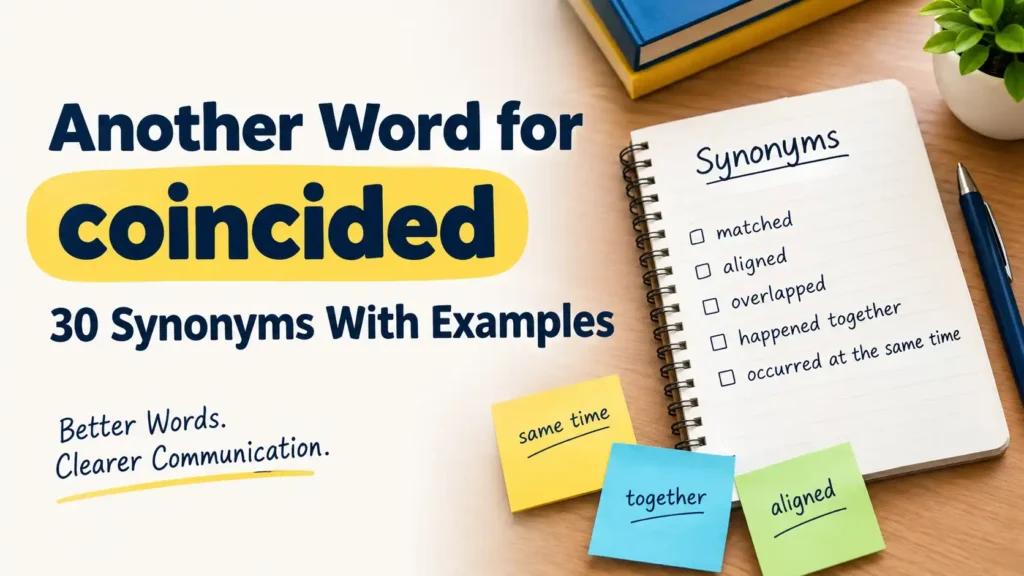
The closest alternatives to coinciding happen at the same time, overlapped, matched, agreed, and corresponded. The best choice depends on what happened or what two things had in common.
Coincided is the past tense of coincide. It can mean two events happened together, two ideas agreed, or two shapes shared the same space. Other choices include concurred, aligned, synchronized, and coexisted. However, some words fit only one meaning.
Quick list: Happened at the same time, overlapped, occurred simultaneously, matched, agreed, corresponded, concurred, aligned, synchronized, and coincided in time.
This guide explores 30 alternatives with meanings, IPA, usage notes, and examples. It also explains word pairs, common phrases, word forms, and common mistakes.
At a Glance: Coincided Synonyms and Related Alternatives
| Alternative | Part of Speech | Meaning | Register / Tone | Ideal Context |
| Happened at the same time | Verb phrase | Took place together | Everyday | Events and dates |
| Overlapped | Verb | Shared part of a time or space | Everyday | Schedules and periods |
| Occurred simultaneously | Verb phrase | Took place at the same time | Formal | Reports and records |
| Matched | Verb | Was the same or very similar | Everyday | Facts and details |
| Agreed | Verb | Had the same view | Everyday | Opinions and plans |
| Corresponded | Verb | Matched or had a clear link | Formal | Facts and records |
| Concurred | Verb | Shared an opinion | Formal | Meetings and debates |
| Aligned | Verb | Fit or agreed with something | General | Goals and views |
| Synchronized | Verb | Happened or moved in step | Technical / General | Clocks and events |
| Coincided in time | Verb phrase | Happened during the same period | Neutral | Events and dates |
These choices cover the main meanings of coincided: events sharing a time, objects sharing space, and ideas or facts matching.
Which Word Should You Use?
| If you want to… | Use | Why |
| Say two events happened together | Happened at the same time | It is clear and easy to understand. |
| Show that two schedules shared some time | Overlapped | It allows for partial overlap. |
| Write in a formal report | Occurred simultaneously | It suits formal writing. |
| Say two opinions were alike | Agreed | It focuses on shared views. |
| Show that two facts matched | Corresponded | It highlights a clear link. |
| Explain that two plans fit together | Aligned | It stresses agreement or fit. |
| Show that two clocks kept the same time | Synchronized | It stresses timing and coordination. |
| Describe two shapes in the same place | Matched exactly | It stresses equal size or position. |
Choose a phrase that fits the link between the two things. For example, overlapped allows partial overlap, while matched often suggests a closer fit.
Exploring the Multiple Meanings of “Coincided”
1. Two events happened at the same time
- Meaning: Two or more events took place during the same period.
- Explanation: This is a common meaning of coincided. The events may share a time without having a direct link.
- Example: The school trip coincided with the town’s summer festival.
2. Two time periods overlapped
- Meaning: Two periods shared some or all of their time.
- Explanation: The events do not need to start or end together. Instead, their dates or hours cross.
- Example: My work hours coincided with the doctor’s opening hours.
3. Two views or interests agreed
- Meaning: Two opinions, aims, or interests were the same or very similar.
- Explanation: This meaning often applies to views, goals, and needs. It does not always mean the people agreed about everything.
- Example: Their plans coincided, so they chose the same goal.
4. Two things occupied the same space
- Meaning: Two shapes, lines, or places shared the same position.
- Explanation: This sense often appears in maths or technical writing. It can mean two lines or shapes matched exactly.
- Example: The two lines coincided on the map.
5. Two facts or details matched
- Meaning: Two accounts, results, or details agreed with each other.
- Explanation: Here, coincided points to a match between facts or claims. However, a match does not always prove that one caused the other.
- Example: Her account coincided with the details in the report.
Analyzing 30 Coincided Alternatives in Detail
Some choices directly coincided. Others fit only certain cases, such as shared dates, matching views, or equal positions.
Group 1: Everyday Alternatives for Shared Timing
1. Happened at the Same Time
IPA: /ˈhæpənd æt ðə seɪm taɪm/ (US and UK)
Definition: Two or more events took place together. This phrase also works in everyday speech.
- Usage: Use it for clear, simple wording. It is a phrase rather than a single-word synonym.
- Example: The concert happened at the same time as our school play.
2. Overlapped
IPA: US /ˌoʊvərˈlæpt/ · UK /ˌəʊvəˈlæpt/
Definition: Two events or periods shared some time or space. The word also applies to ideas or duties that share parts.
- Usage: Choose it when events are shared only part of a period. However, it does not mean they matched in every way.
- Example: My lunch break overlapped with the start of the meeting.
3. Occurred Simultaneously
IPA: US /əˈkɝːd ˌsaɪməlˈteɪniəsli/ · UK /əˈkɜːd ˌsɪməlˈteɪniəsli/
Definition: Two or more events took place at the same time. This phrase also suits formal reports.
- Usage: Use it in reports or academic writing. However, it sounds more formal than what happened together.
- Example: Both power cuts occurred simultaneously during the storm.
4. Took Place Together
IPA: /tʊk pleɪs təˈɡeðər/ (US and UK)
Definition: Two or more events happened during the same period. The phrase also gives a plain account of shared timing.
- Usage: Choose it for simple storytelling. However, it may suggest a closer link than the events actually had.
- Example: The two school events took place together last Friday.
5. Happened Concurrently
IPA: US /ˈhæpənd kənˈkɝːəntli/ · UK /ˈhæpənd kənˈkʌrəntli/
Definition: Two or more things happened during the same period. This phrase also fits work and study tasks.
- Usage: Use it in formal or work-related writing. However, concurrently sounds more technical than together.
- Example: The two training sessions happened concurrently at different sites.
Group 2: Words for Matching Time and Schedules
6. Synchronized
IPA: US /ˈsɪŋkrənaɪzd/ · UK /ˈsɪŋkrənaɪzd/
Definition: Two things happened or moved in step. The word also applies to clocks and planned events.
- Usage: Use it when timing matches closely. However, it can suggest planned coordination rather than chance.
- Example: The team synchronized its watches before the long hike.
7. Coincided in Time
IPA: US /ˌkoʊɪnˈsaɪdɪd ɪn taɪm/ · UK /ˌkəʊɪnˈsaɪdɪd ɪn taɪm/
Definition: Two events happened during the same period. This phrase also makes the timing clear.
- Usage: Use it to stress timing rather than agreement. It is a phrase built from the original word.
- Example: The road repairs coincided in time with the school holidays.
8. Fell Together
IPA: /fɛl təˈɡɛðər/ (US and UK)
Definition: Events or dates happened to line up. The phrase also suggests that events came together by chance.
- Usage: This is a less direct, context-based choice. Use it only when the sentence makes the timing clear.
- Example: Our free days fell together, so we planned a family trip.
9. Was Concurrent With
IPA: US /wəz kənˈkɝːənt wɪð/ · UK /wəz kənˈkʌrənt wɪð/
Definition: One event took place during the same period as another. This phrase also suits formal records.
- Usage: Use it in formal writing. However, it is less natural in casual speech than happened at the same time.
- Example: The new policy was concurrent with changes in school rules.
10. Occurred at the Same Time
IPA: US /əˈkɝːd æt ðə seɪm taɪm/ · UK /əˈkɜːd æt ðə seɪm taɪm/
Definition: Two or more events took place together. The phrase also works well in plain reports.
- Usage: Choose it when readers need a direct account of timing. It does not imply that one event caused another.
- Example: The two delays occurred at the same time on Monday.
Group 3: Words for Agreement and Shared Views
11. Agreed
IPA: /əˈɡriːd/ (US and UK)
Definition: People or views shared the same opinion or choice. The word also refers to a shared decision.
- Usage: Use it for opinions, plans, or decisions. However, it does not replace coincided when you mean shared timing.
- Example: Their views agreed on the need for better roads.
12. Concurred
IPA: US /kənˈkɝːd/ · UK /kənˈkɜːd/
Definition: Someone shared another person’s view or judgment. This word also suits formal talks and written reports.
- Usage: Choose it for formal agreement. It is more formal than agreed and does not usually refer to shared dates.
- Example: The judge concurred with the main point in the report.
13. Corresponded
IPA: US /ˌkɔːrəˈspɑːndɪd/ · UK /ˌkɒrəˈspɒndɪd/
Definition: Two things matched or showed a clear link. The word also applies to facts, records, and views.
- Usage: Use it when one detail matches another. However, it may show a link rather than full agreement.
- Example: Her notes corresponded with the facts in the report.
14. Accorded
IPA: US /əˈkɔːrdɪd/ · UK /əˈkɔːdɪd/
Definition: Things agreed or fit together in a certain way. This word also appears in formal phrases about views and aims.
- Usage: Use it in formal writing, often with. It is a related choice, not a fit for every use of coincidence.
- Example: His account accorded with the facts shared by the team.
15. Conformed
IPA: US /kənˈfɔːrmd/ · UK /kənˈfɔːmd/
Definition: Something matched a rule, norm, or set standard. The word also suggests that a person or thing followed a set pattern.
- Usage: Use it when a result meets a rule. However, it does not mean two events simply happened together.
- Example: The final report conformed to the rules set by the school.
Group 4: Words for Matching Facts, Shapes, and Details
16. Matched
IPA: /mætʃt/ (US and UK)
Definition: Two things were the same or went well together. The word also applies to facts, colors, and shapes.
- Usage: Choose it when two details fit or look alike. However, it can suggest similarity rather than exact sameness.
- Example: The dates matched those listed in the old diary.
17. Corresponded Exactly
IPA: US /ˌkɔːrəˈspɑːndɪd ɪɡˈzæktli/ · UK /ˌkɒrəˈspɒndɪd ɪɡˈzæktli/
Definition: Two things agreed in every key detail. The phrase also highlights a close match between facts or shapes.
- Usage: Use it when the match is very close. However, it is stronger than a loose link or partial match.
- Example: The map’s marked path corresponded exactly with the trail outside.
18. Aligned
IPA: /əˈlaɪnd/ (US and UK)
Definition: Two things lined up or shared the same aim. The word also refers to views, plans, and positions.
- Usage: Use it for goals, views, or objects in line. However, it does not always mean an exact match.
- Example: Our plans aligned with the goals set by the group.
19. Tallied
IPA: US /ˈtæld/ · UK /ˈtæld/
Definition: Two accounts or facts agreed with each other. The word also means that a count or score was added up.
- Usage: Use it for facts, records, or results. It is informal in some settings and does not fit all timing cases.
- Example: The number on the bill tallied with my own count.
20. Squared
IPA: /skwɛrd/ (US and UK)
Definition: Two things agreed or fit together. The word also appears in the phrase squared with to mean consistent with.
- Usage: Use it in informal speech about facts or claims. However, it is not a general synonym for shared timing.
- Example: His story squared with what the teacher had heard.
Group 5: Words for Shared Space and Paths
21. Met
IPA: /mɛt/ (US and UK)
Definition: Two lines, paths, or things came together at a point. The word also means people came together in person.
- Usage: Use it when paths or lines join. However, met does not mean they shared their full length.
- Example: The two paths met beside the old stone bridge.
22. Converged
IPA: US /kənˈvɝːdʒd/ · UK /kənˈvɜːdʒd/
Definition: Two or more paths or ideas came closer together. The word also refers to views that move toward a shared point.
- Usage: Choose it when things move toward one point. It is related to coincided, but it need not mean a full match.
- Example: The two roads converged near the edge of town.
23. Crossed
IPA: /krɔːst/ (US and UK)
Definition: Two lines or paths passed over or through each other. The word also refers to routes that meet at a point.
- Usage: Use it for lines or paths that intersect. However, crossing does not mean the paths follow the same route.
- Example: The two walking trails crossed near the lake.
24. Joined
IPA: /dʒɔɪnd/ (US and UK)
Definition: Two things came together or became connected. The word also applies to groups, paths, and parts of an object.
- Usage: Choose it when things connect or form one whole. It is a related alternative, not an exact match for every sense.
- Example: The two paths joined just beyond the wooden gate.
25. Occupied the Same Space
IPA: /ˈɑːkjəˌpaɪd ðə seɪm speɪs/ (US and UK)
Definition: Two things share the same area or position. This phrase also suits shapes and objects in technical contexts.
- Usage: Use it for physical position, not shared views or dates. It explains the spatial sense of coincidence rather than replacing every use.
- Example: The two shapes occupied the same space on the drawing.
Group 6: Related Choices for Similar Results and Shared Conditions
26. Coexisted
IPA: US /ˌkoʊɪɡˈzɪstɪd/ · UK /ˌkəʊɪɡˈzɪstɪd/
Definition: Two or more things existed at the same time. The word also applies to people, ideas, or systems that shared a period.
- Usage: Use it when things exist together. However, it does not mean their start and end dates matched exactly.
- Example: Old and new customs coexisted in the small town.
27. Went Hand in Hand
IPA: /wɛnt hænd ɪn hænd/ (US and UK)
Definition: Two things often happened together or had a close link. The phrase also suggests that one went with the other.
- Usage: Use it for closely linked trends or events. However, this phrase does not prove that one caused the other.
- Example: Good planning went hand in hand with the team’s success.
28. Dovetailed
IPA: US /ˈdʌvˌteɪld/ · UK /ˈdʌvˌteɪld/
Definition: Two parts fit together well. The word also refers to plans or ideas that work well as a whole.
- Usage: Choose it when plans fit neatly together. It is a related choice and often suggests a useful fit, not shared timing alone.
- Example: Her work hours dovetailed with the needs of the family.
29. Harmonized
IPA: US /ˈhɑːrməˌnaɪzd/ · UK /ˈhɑːmənaɪzd/
Definition: Two things worked well together or formed a pleasing whole. The word also applies to views, rules, and sounds.
- Usage: Use it for views or parts that fit well. However, it can suggest a smooth fit rather than exact agreement.
- Example: The new rules harmonized with the school’s main goals.
30. Was Consistent With
IPA: US /wəz kənˈsɪstənt wɪð/ · UK /wəz kənˈsɪstənt wɪð/
Definition: One fact or claim did not conflict with another. The phrase also means that two details fit the same account.
- Usage: Use it when facts support the same view. However, it does not always mean the facts are identical.
- Example: Her answer was consistent with the notes from class.
Coincided vs. Overlapped vs. Matched
These three words can express similar ideas. However, each one highlights a different kind of link.
| Word | Main Meaning | Best Use | Example |
| Coincided | Happened together or agreed | Events, views, and positions | Our holidays coincided this year. |
| Overlapped | Shared part of a time or space | Schedules and periods | Our work shifts overlapped. |
| Matched | Was the same or very similar | Facts, colors, and details | The dates matched our records. |
| Agreed | Shared the same view | Opinions and decisions | Their views agreed on this point. |
| Aligned | Lined up or shared a goal | Plans, views, and positions | Our plans aligned well. |
| Converged | Moved toward the same point | Roads, paths, and ideas | The two roads converged nearby. |
Remember: Coincided covers several meanings. In contrast, overlapped focuses on shared time or space, while matched stresses similarity.
Coincided and Opposite/Paired Word Pairs
The right opposite depends on the meaning of coincided. A word about time needs a different contrast from one about agreement.
| Word | Paired Word | Note |
| Coincided | Differed | Contrasts matching views or details |
| Agreed | Disagreed | Contrasts shared and opposing views |
| Aligned | Misaligned | Contrasts a good fit with a poor fit |
| Matched | Mismatched | Contrasts a match with a poor match |
| Converged | Diverged | Contrasts paths or ideas coming together and moving apart |
| Overlapped | Separated | Contrasts shared time or space with distinct periods or areas |
| Synchronized | Fell out of sync | Contrasts matching timing with timing that no longer matches |
| Corresponded | Contradicted | Contrasts agreement with a direct conflict between claims |
These pairs are not all exact opposites in every sentence. For example, two events may not overlap without directly opposing each other. Likewise, two opinions may differ without contradicting each other.
Common Word Partners of “Coincided”
The verb coincided often appears with words about time, views, dates, and interests. It commonly takes the preposition with.
| Pattern | Common Partners | Example |
| Coincided with + event | A meeting, holiday, launch | The launch coincided with the holiday. |
| Coincided with + period | A term, year, season | Her visit coincided with the school term. |
| Coincided with + date | A birthday, anniversary | The event coincided with our anniversary. |
| Coincided with + opinion | A view, belief, judgment | His view coincided with mine. |
| Coincided with interest | Public interests, personal interests | Their interests coincided on this issue. |
| Coincided with + change | A rise, fall, change | The rise coincided with a new rule. |
| Coincided exactly with | A date, record, position | The date coincided exactly with our notes. |
| Happened to coincide | A visit, meeting, trip | Our trips happened to coincide. |
These patterns help readers tell if coincided refers to shared timing, agreement, or a close match. The context makes the intended meaning clear.
Idiomatic Phrases Featuring “Coincided”
There are few common idioms built around coinciding. However, several established phrases express shared timing or a chance match.
1. Happened to Coincide
- Meaning: Two events matched in time by chance.
- Example: Our visits happened to coincide during the summer break.
2. Coincided With the Launch
- Meaning: An event took place at the same time as a launch.
- Example: The new advert coincided with the product launch.
3. Coincided With a Rise
- Meaning: One event took place during a period of growth.
- Example: The change coincided with a rise in school attendance.
4. Coincided With an Anniversary
- Meaning: An event happened on or around an anniversary.
- Example: The book release coincided with the author’s anniversary celebration.
These are established expressions, not all fixed idioms. Their meanings depend on the words that coincided.
Word Formation of “Coincided”
Etymology & Structure
Coincided is the past tense and past participle of the verb coincide. The word came into English through Medieval Latin coincidere, meaning to fall together. Its parts trace back to Latin elements linked to togetherness and falling.
Date and History
The word’s early English history includes uses in the 1640s. By the early 1700s, it referred to things that matched in nature or position. The meaning involving events happening at the same time appeared around 1809.
Word Class Variations
| Word Form | Part of Speech | Meaning | Example |
| Coincide | Verb | Happen together or agree | Their views coincide. |
| Coincides | Verb | Present-tense form | Her birthday coincides with mine. |
| Coincided | Verb | Past tense or past participle | Our visits coincided last year. |
| Coinciding | Verb form | Happening together or agreeing | The two events are coinciding this week. |
| Coincidence | Noun | A match that may happen by chance | Meeting her there was a coincidence. |
| Coincident | Adjective | Occurring together or matching | The dates were coincident. |
| Coincidental | Adjective | Happening by chance | Their meeting was coincidental. |
| Coincidentally | Adverb | In a way that involves coincidence | Coincidentally, we chose the same day. |
Common Word-Choice Mistakes
Here are common mistakes to avoid when using coincided and its alternatives.
- Wrong pairing: The two events coincided with each other.
Correction: The two events coincided with each other. - Wrong pairing: Our views coincided in time.
Correction: Our views coincided.
Use in time only when you need to stress timing. - Wrong pairing: The dates overlapped exactly in every detail.
Correction: The dates matched exactly.
Use overlaps when two periods share some time. - Wrong pairing: Their opinions synchronized.
Correction: Their opinions agreed.
Use synchronized mainly for timing or coordinated action. - Wrong pairing: The two roads agreed at the junction.
Correction: The two roads met at the junction.
Use agreed for views, decisions, or claims. - Wrong pairing: The two events caused each other because they coincided.
Correction: The two events happened at the same time.
Shared timing alone does not prove cause and effect. - Wrong pairing: The report coincided with the facts.
Correction: The report corresponded with the facts.
Use corresponded with to show that details matched.
Frequently Asked Questions
1. What is the closest synonym for coincided?
Happening at the same time is a clear everyday alternative for events. For views, agreed or matched may work better.
2. What is another word for coinciding in time?
You can say overlapped, occurred simultaneously, or happened together. The best choice depends on how much time the events are shared.
3. Is coincided a verb?
Yes. Coincided is the past tense and past participle of coincide.
4. What is a formal alternative to coincided?
Occurred simultaneously works well in formal reports. For agreement between views, consider concurred or corresponded.
5. What is the difference between coincided and overlapped?
Coincided can mean events happened together or ideas agreed. Overlapped means two periods or areas shared some part.
6. Can coincided mean agreed?
Yes. It can mean that two views, aims, or interests were the same or very similar.
7. What is the opposite of coincided?
The opposite depends on the meaning. Differed contrasts matching views, while occurred at different times contrasts shared timing.
8. Can coincided refer to people?
Yes, but it often refers to their views, interests, or schedules. For people meeting in person, met at the same time may sound clearer.
9. Is coincided the same as matched?
Not always. Matched stresses similarity, while coincided can refer to timing, shared space, or agreement.
10. What preposition follows coincided?
The word often takes with, as in “The event coincided with the holiday.” Some sentences do not need a preposition.
Conclusion
The best alternatives to coincided include overlapped, matched, agreed, corresponded, and occurred simultaneously. Each one suits a different meaning or setting.
Context matters because coincided can refer to shared time, space, views, or facts. Therefore, no single synonym fits every sentence.
Choose happened at the same time for simple writing. Use concurred for formal agreement and overlapped for shared periods. Above all, pick the word that expresses your exact meaning.

Sikandar Hayat is the author of PublivoHub.com, a platform dedicated to synonyms, alternative words, and vocabulary improvement. He aims to help readers find the right words and express their ideas more clearly and effectively. Through simple explanations and useful word alternatives, Sikandar makes it easier for students, writers, bloggers, and everyday readers to improve their writing and expand their vocabulary.