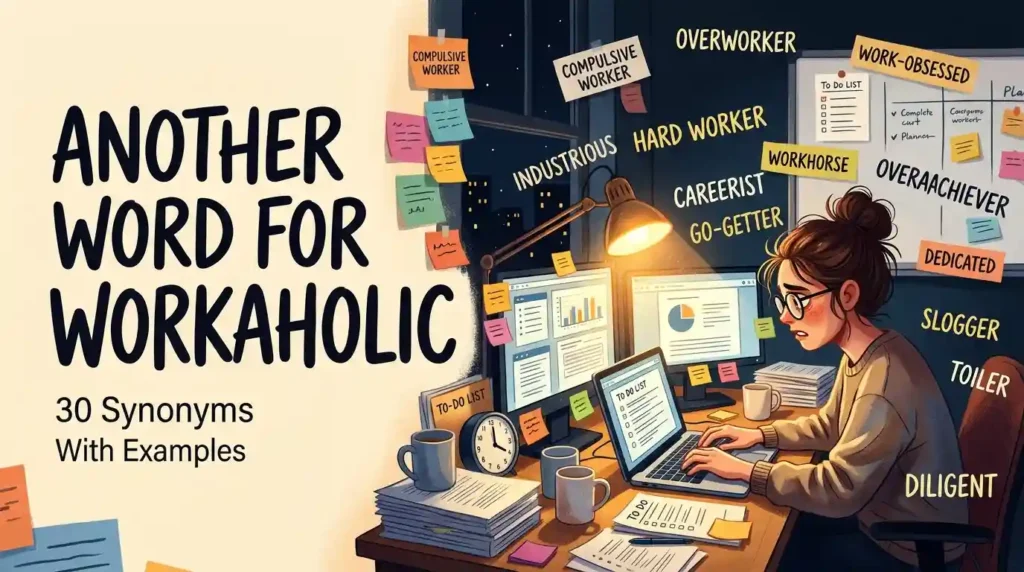
A workaholic is someone who feels a strong need to work all the time. The closest everyday alternatives include compulsive worker, work-obsessed person, overworker, and hard worker. However, these words carry different meanings and tones.
Some terms suggest a strong work ethic, while others point to poor work-life balance. Depending on the context, you might need a word for a driven employee, a career-focused person, or someone who struggles to stop working.
Quick list: compulsive worker, overworker, work-obsessed person, hard worker, work enthusiast, workhorse, perfectionist, careerist, industrious person, and work-driven person.
This guide explores 30 synonyms and related alternatives. You’ll find simple meanings, IPA pronunciations, usage notes, natural examples, and tips for choosing the right word.
At a Glance: Workaholic Synonyms and Related Alternatives
| Alternative | Part of Speech | Meaning | Register / Tone | Ideal Context |
| compulsive worker | Noun phrase | Someone who feels unable to stop working | Informal, negative | Excessive work habits |
| Overworker | Noun | Someone who works too much | Neutral, critical | Long work hours |
| Work-obsessed person | Noun phrase | Someone whose thoughts center on work | Informal, negative | Work dominating daily life |
| Hard worker | Noun phrase | Someone who puts great effort into work | Positive | Praise and recognition |
| Work enthusiast | Noun phrase | Someone who enjoys working | Positive | Strong interest in work |
| Workhorse | Noun | Someone who handles a great deal of work | Informal, mixed | Reliable employees |
| Perfectionist | Noun | Someone who wants everything to be just right | Neutral, mixed | Excessive attention to work |
| Careerist | Noun | Someone who puts career progress first | Often critical | Career-focused behavior |
| Industrious person | Noun phrase | Someone who works hard and steadily | Formal, positive | Professional praise |
| Work-driven person | Noun phrase | Someone strongly motivated by work | Neutral, mixed | Personal motivation |
Which Word Should You Use?
| If you want to… | Use | Why |
| Show an unhealthy need to work | compulsive worker | It suggests a strong urge to keep working. |
| Describe someone who works too many hours | Overworker | It focuses on excessive work time. |
| Show that work dominates someone’s life | Work-obsessed person | It highlights how much work matters to them. |
| Praise someone’s effort | Hard worker | It shows effort without suggesting an unhealthy habit. |
| Highlight a love of work | Work enthusiast | It focuses on enjoyment rather than excess. |
| Describe a highly productive employee | Workhorse | It suggests someone who handles a heavy workload. |
| Explain endless checking and revising | Perfectionist | It points to a need for work to meet high standards. |
| Describe someone focused on career success | Careerist | It stresses career goals, often above other needs. |
Exploring the Multiple Meanings of “Workaholic”
The word workaholic has one main meaning, but people use it in several ways. Context helps show if the word praises hard work or points to an unhealthy habit.
1. Someone Who Feels Compelled to Work
- Meaning: A person who feels a strong need to keep working.
- Explanation: Work may feel hard to leave behind. As a result, rest and free time often take second place.
- Example: Mark checked his work emails even during his family holiday.
2. Someone Who Works Excessive Hours
- Meaning: A person who spends too much time on work.
- Explanation: This sense focuses on long hours rather than work quality. It also suggests that other parts of life may suffer.
- Example: Nina stayed late every night and missed dinner with her friends.
3. Someone Deeply Focused on a Career
- Meaning: A person who puts great effort into career goals.
- Explanation: This use may suggest strong drive and ambition. However, career focus alone does not make someone a workaholic.
- Example: Daniel took extra projects to earn a promotion at work.
4. Someone Who Loves Working
- Meaning: A person who gains joy or purpose from work.
- Explanation: This sense highlights enjoyment rather than a need to keep working. Still, a love of work does not always mean work addiction.
- Example: Sara enjoyed her job so much that she often worked late.
5. Someone Who Finds It Hard to Rest
- Meaning: A person who struggles to stop working during free time.
- Explanation: The person may feel uneasy while resting. As a result, they may keep finding tasks to do.
- Example: Even on Sunday, Adam made a list of tasks for Monday.
Analyzing 30 Workaholic Alternatives in Detail
Some alternatives closely match workaholics, while others fit only certain traits or work habits.
Core Synonyms
1. compulsive worker
IPA: US /ˈwɝːk ˌædɪkt/ · UK /ˈwɜːk ˌædɪkt/
Definition: A person who feels a strong need to keep working. The phrase also suggests trouble stepping away from work.
- Usage: This is one of the closest synonyms for workaholic. However, it has a strong negative tone.
- Example: His friends called him a compulsive worker after he skipped every weekend outing.
2. Compulsive worker
IPA: US /kəmˈpʌlsɪv ˈwɝːkər/ · UK /kəmˈpʌlsɪv ˈwɜːkə/
Definition: Someone who feels driven to work again and again. The term also points to a hard-to-control urge.
- Usage: This phrase sounds more formal than compulsive worker. In fact, it stresses the urge to work rather than simple effort.
- Example: As a compulsive worker, Helen found it hard to take a full day off.
3. Overworker
IPA: US /ˌoʊvərˈwɝːkər/ · UK /ˌəʊvəˈwɜːkə/
Definition: Someone who works more than is healthy or needed. The word also focuses on too much work.
- Usage: This is a clear term for excessive work habits. However, it does not always suggest a strong inner urge.
- Example: The overworker stayed late to finish tasks that could wait until morning.
4. Work-obsessed person
IPA: US /ˈwɝːk əbˌsɛst ˈpɝːsən/ · UK /ˈwɜːk əbˌsɛst ˈpɜːsən/
Definition: Someone who thinks about work much of the time. The phrase also suggests that work takes up too much mental space.
- Usage: This phrase stresses thoughts about work. For example, it fits someone who talks about work even during free time.
- Example: As a work-obsessed person, Leo brought office problems to every family meal.
5. compulsive worker
IPA: US /ˈwɝːk ˌædɪkt/ · UK /ˈwɜːk ˌædɪkt/
Definition: Someone who keeps working despite a need to stop. The phrase also signals an unhealthy link with work.
- Usage: This repeats the core idea of workaholic and is common in everyday speech. However, it is the same phrase as Entry 1, so it is not a separate synonym.
Hard Work and High Effort
6. Hard worker
IPA: US /ˈhɑːrd ˌwɝːkər/ · UK /ˌhɑːd ˈwɜːkə/
Definition: Someone who puts time and effort into a task. The phrase also suggests care and a strong work ethic.
- Usage: This is a positive alternative, unlike workaholics. Still, it does not suggest that the person struggles to stop working.
- Example: Maria is a hard worker who always helps her team meet its goals.
7. Industrious person
IPA: US /ɪnˈdʌstriəs ˈpɝːsən/ · UK /ɪnˈdʌstriəs ˈpɜːsən/
Definition: Someone who works hard and stays busy. The phrase also suggests steady effort over time.
- Usage: This term sounds more formal and positive. However, it praises effort rather than an unhealthy need to work.
- Example: The industrious person finished the report before the rest of the team arrived.
8. Diligent worker
IPA: US /ˈdɪlɪdʒənt ˈwɝːkər/ · UK /ˈdɪlɪdʒənt ˈwɜːkə/
Definition: Someone who works with care and pays close attention. The phrase also suggests that the person takes duties seriously.
- Usage: This is a positive term for careful work. In fact, it says more about care than long hours.
- Example: A diligent worker checks each figure before sending the final report.
9. Workhorse
IPA: US /ˈwɝːkˌhɔːrs/ · UK /ˈwɜːkˌhɔːs/
Definition: Someone who handles a large amount of work. The word also suggests strength and reliability.
- Usage: This informal term often praises a dependable worker. However, it may imply that others place too much work on them.
- Example: Jamal became the office workhorse during the busy month.
10. Eager beaver
IPA: US /ˌiːɡər ˈbiːvər/ · UK /ˌiːɡə ˈbiːvə/
Definition: Someone who shows great eagerness to work or help. The phrase also carries a lively, informal tone.
- Usage: This phrase often sounds friendly or mildly teasing. Still, it does not always suggest excessive work.
- Example: The eager beaver arrived early to help set up the meeting room.
Drive, Ambition, and Career Focus
11. Overachiever
IPA: US /ˌoʊvər əˈtʃiːvər/ · UK /ˌəʊvər əˈtʃiːvə/
Definition: Someone who reaches more goals than people expect. The word also suggests a strong drive to succeed.
- Usage: An overachiever may work long hours to reach high goals. However, the word focuses on results rather than a need to work.
- Example: The overachiever finished three projects before the team deadline.
12. Go-getter
IPA: US /ˈɡoʊ ˌɡɛtər/ · UK /ˈɡəʊ ˌɡetə/
Definition: Someone who takes action to reach goals. The phrase also suggests energy and self-drive.
- Usage: This is a positive, informal term for an active person. In contrast, workaholics can suggest poor balance between work and life.
- Example: As a go-getter, Priya asked for new tasks and took on fresh challenges.
13. Careerist
IPA: US /kəˈrɪrɪst/ · UK /kəˈrɪərɪst/
Definition: Someone who puts career progress first. The word also may suggest that success matters more than other needs.
- Usage: This term often has a critical tone. For example, it fits someone who puts a promotion ahead of personal ties.
- Example: The careerist turned down a family trip to impress the new manager.
14. Ambitious person
IPA: US /æmˈbɪʃəs ˈpɝːsən/ · UK /æmˈbɪʃəs ˈpɜːsən/
Definition: Someone who wants to reach big goals. The phrase also suggests a wish to grow or succeed.
- Usage: Ambition can lead to long work hours, but it is not the same as work addiction. Still, it is useful when you want a positive tone.
- Example: The ambitious person took a course to prepare for a better job.
15. Work-driven person
IPA: US /ˈwɝːk ˌdrɪvən ˈpɝːsən/ · UK /ˈwɜːk ˌdrɪvən ˈpɜːsən/
Definition: Someone whose choices are strongly shaped by work. The phrase also suggests that work is a key source of purpose.
- Usage: This phrase is descriptive rather than a fixed label. However, it can suggest a work-centered life without claiming addiction.
- Example: As a work-driven person, Omar planned each day around his job.
Love of Work and High Energy
16. Work enthusiast
IPA: US /ˈwɝːk ɪnˌθuːziæst/ · UK /ˈwɜːk ɪnˌθjuːziæst/
Definition: Someone who enjoys working or takes a keen interest in it. The phrase also gives a positive sense of energy.
- Usage: This is a softer choice than workaholic. In fact, it stresses interest rather than an urge that is hard to control.
- Example: The work enthusiast enjoyed learning new skills at the office.
17. Busy bee
IPA: US /ˈbɪzi ˌbiː/ · UK /ˈbɪzi ˌbiː/
Definition: Someone who stays active and has many tasks to do. The phrase also sounds warm and playful.
- Usage: This informal phrase suits someone who is always busy. However, it does not prove that the person works too much.
- Example: Our busy bee cleaned the kitchen and sorted the mail before lunch.
18. Hustler
IPA: US /ˈhʌslər/ · UK /ˈhʌslə/
Definition: Someone who works hard to make progress or earn money. The word also suggests drive and a willingness to act.
- Usage: This term can praise ambition, especially in business. Still, in some contexts it may suggest dishonest ways of making money.
- Example: The young hustler took on extra jobs to save for college.
19. Zealous worker
IPA: US /ˈzɛləs ˈwɝːkər/ · UK /ˈzeləs ˈwɜːkə/
Definition: Someone who shows strong passion for a task. The phrase also suggests deep interest in the work.
- Usage: This term sounds more formal than hard worker. However, it stresses passion rather than long hours.
- Example: The zealous worker stayed focused while the team prepared for launch.
20. Dedicated worker
IPA: US /ˈdɛdɪˌkeɪtɪd ˈwɝːkər/ · UK /ˈdedɪˌkeɪtɪd ˈwɜːkə/
Definition: Someone who gives steady care and effort to a job. The phrase also suggests loyalty to the task.
- Usage: This phrase praises commitment and effort. In contrast, workaholic can imply that work harms other parts of life.
- Example: The dedicated worker helped train each new member of the team.
Steady Effort and Heavy Work
21. Toiler
IPA: US /ˈtɔɪlər/ · UK /ˈtɔɪlə/
Definition: Someone who works hard, often at tiring tasks. The word also carries a more formal or literary tone.
- Usage: This word highlights effort and strain. However, it does not imply that the person cannot stop working.
- Example: The toiler spent the day fixing roads in the summer heat.
22. Slogger
IPA: US /ˈslɑːɡər/ · UK /ˈslɒɡə/
Definition: Someone who keeps working through a hard task. The word also suggests steady effort over time.
- Usage: This informal term often praises grit. Still, it may focus on hard work rather than a work-driven life.
- Example: A real slogger, Ben kept going until he finished the long report.
23. Plodder
IPA: US /ˈplɑːdər/ · UK /ˈplɒdə/
Definition: Someone who moves through work slowly and steadily. The word also suggests patience and persistence.
- Usage: This term may sound critical if it hints at slow progress. However, it does not mean the person is a workaholic.
- Example: The plodder made steady progress on the large task each day.
24. Drudge
IPA: US /ˈdrʌdʒ/ · UK /ˈdrʌdʒ/
Definition: Someone who does dull or tiring work for long periods. The word also may suggest that the work feels like a burden.
- Usage: This word often has a negative tone. In fact, it focuses on hard, dull work rather than a love of work.
- Example: He felt like a drudge after weeks of sorting the same files.
25. Tireless worker
IPA: US /ˈtaɪərləs ˈwɝːkər/ · UK /ˈtaɪələs ˈwɜːkə/
Definition: Someone who seems to have endless energy for work. The phrase also praises strong effort and drive.
- Usage: This is often a positive phrase. However, it may hide the need for rest if used without care.
- Example: The tireless worker helped the team meet its goal before Friday.
Related Terms for Work Habits
26. Perfectionist
IPA: US /pərˈfɛkʃənɪst/ · UK /pəˈfekʃənɪst/
Definition: Someone who wants things to be just right. The word also suggests high standards and close attention to detail.
- Usage: This is a related term, not an exact synonym. For example, a perfectionist may work late to fix small errors.
- Example: The perfectionist reviewed the slides several times before the talk.
27. Taskmaster
IPA: US /ˈtæskˌmæstər/ · UK /ˈtɑːskˌmɑːstə/
Definition: Someone who demands hard work from others. The word also suggests strict control over tasks.
- Usage: This term often refers to a boss or leader, not a person addicted to work. Still, it fits cases where work pressure is high.
- Example: The taskmaster asked the team to finish every task before leaving.
28. Workaholic professional
IPA: US /ˌwɝːkəˈhɔːlɪk prəˈfɛʃənəl/ · UK /ˌwɜːkəˈhɒlɪk prəˈfeʃənəl/
Definition: A skilled worker who has a hard time stepping away from work. The phrase also links excessive work with a career role.
- Usage: This is a descriptive phrase, not a distinct synonym. However, it can suit formal writing about work habits.
- Example: The workaholic professional checked client messages long after the office closed.
29. Work-centered person
IPA: US /ˈwɝːk ˌsɛntərd ˈpɝːsən/ · UK /ˈwɜːk ˌsentəd ˈpɜːsən/
Definition: Someone who places work at the center of daily life. The phrase also points to how a person sets priorities.
- Usage: This is a related description, not an exact synonym. In fact, it can sound more neutral than workaholic.
- Example: As a work-centered person, Aisha planned most weekends around her job.
30. Overachieving employee
IPA: US /ˌoʊvər əˈtʃiːvɪŋ ɪmˈplɔɪiː/ · UK /ˌəʊvər əˈtʃiːvɪŋ ɪmˈplɔɪiː/
Definition: An employee who aims to do more than the job requires. The phrase also suggests a strong drive to reach high goals.
- Usage: This is a related term rather than an exact synonym. However, it fits someone whose wish to excel leads to long work hours.
- Example: The overachieving employee volunteered for extra tasks before the busy season.
Workaholic vs. Hard Worker vs. compulsive worker
These three terms overlap, but each points to a different work habit. The key difference is if the word highlights effort, enjoyment, or a hard-to-control urge.
| Term | Main Focus | Tone | Example Context |
| Workaholic | Excessive work and trouble stopping | Often negative | Someone who works during every holiday |
| Hard worker | Effort and care | Positive | Someone who completes tasks on time |
| compulsive worker | A strong urge to keep working | Negative | Someone who feels unable to take breaks |
| Work enthusiast | Enjoyment of work | Positive | Someone who loves learning new work skills |
| Overachiever | Reaching more goals than expected | Mixed | Someone who takes on extra projects |
| Careerist | Career success above other needs | Often critical | Someone who puts promotion before family time |
Which term is best?
Choose a hard worker when you want to praise someone’s effort. Use work enthusiast when you mean they enjoy their job. However, choose a workaholic or compulsive worker when the person struggles to stop working.
Workaholic and Opposite/Paired Word Pairs
There is no single perfect opposite of workaholic. The best choice depends on if you mean someone who works less, rests more, or gives work less priority.
| Word | Paired Word | Note |
| Workaholic | Leisure lover | One centers life on work, while the other values free time. |
| Workaholic | Work-life balance | This pair contrasts excess work with balance. |
| Workaholic | Part-time worker | These terms may contrast work hours, not work habits. |
| Workaholic | Relaxed person | This pair contrasts a work-focused life with a more relaxed approach. |
| Workaholic | Idler | An idler avoids work, while a workaholic may struggle to stop. |
| Workaholic | Rest-seeker | This phrase highlights a wish for rest rather than more work. |
| Workaholic | Family-focused person | This pair contrasts work priorities with family priorities. |
These pairs are not all exact antonyms. For example, a part-time worker may still think about work all day, while a full-time worker may enjoy a healthy balance.
Common Word Partners of “Workaholic”
These common word patterns help readers use workaholic in natural English.
| Pattern | Common Partners | Example |
| Adjective + workaholic | self-confessed, chronic, complete | She is a self-confessed workaholic. |
| Workaholic + noun | habits, tendencies, lifestyle | His workaholic habits left little time for rest. |
| Become a workaholic | become a workaholic | He became a workaholic after starting his own firm. |
| Admit to being a + workaholic | admit to being a workaholic | Maya admitted to being a workaholic. |
| Workaholic + at work | workaholic behavior, workaholic culture | The team discussed its workaholic culture. |
| Workaholic + relationship | workaholic partner, workaholic parent | Her workaholic partner often missed dinner. |
| Recover from + workaholism | recover from workaholism | He changed his routine to address his workaholism. |
These patterns show how people discuss work habits, personal life, and the effects of excessive work. However, workaholics often carry a critical tone, so choose it with care.
Idiomatic Phrases Featuring “Workaholic”
The word workaholic has few fixed idioms of its own. However, these established expressions help explain the habits linked to it.
1. Married to Your Work
- Meaning: To give so much time to work that other parts of life suffer.
- Example: People say James is married to his work because he rarely takes time off.
2. Live to Work
- Meaning: To treat work as the main purpose of life.
- Example: Priya seemed to live to work, since she planned every day around her job.
3. Work Around the Clock
- Meaning: To work for very long hours, often with little rest.
- Example: The staff worked around the clock to finish the urgent order.
4. Keep Your Nose to the Grindstone
- Meaning: To keep working hard without much rest or distraction.
- Example: He kept his nose to the grindstone until he finished the final report.
These expressions differ in tone. Marrying to your work often suggests poor balance, while keeping your nose to the grindstone can praise steady effort.
Word Formation of “Workaholic”
Etymology and Structure
The word workaholic combines work with the ending -aholic. This ending comes from alcoholic and suggests a strong urge or addiction.
Writer and counselor Wayne Oates helped popularize the word through his work on work addiction. The term later became common in everyday English.
Date and History
The word appeared in print by the mid-20th century. Etymonline records it from 1961, while Collins dates its coinage to 1971. These dates reflect different accounts of its early history.
Word Class Variations
| Word Form | Part of Speech | Meaning |
| Workaholic | Noun | Someone who works excessively |
| Workaholics | Plural noun | More than one workaholic |
| Workaholism | Noun | The habit or urge to work excessively |
| Workaholic | Adjective | Relating to excessive work habits |
| Workaholic behavior | Noun phrase | Actions linked to excessive work |
English does not have a widely used verb form of workaholic. Instead, people say work excessively, work compulsively, or become a workaholic.
Common Word-Choice Mistakes
Here are common mistakes to avoid when choosing another word for workaholic.
- Wrong pairing: Calling every hard worker a workaholic. Correction: Use workaholic when work becomes excessive or hard to stop.
- Wrong pairing: Using hard workers to suggest work addiction. Correction: Choose a compulsive worker when you need a stronger negative meaning.
- Wrong pairing: Treating ambitious and workaholic as exact synonyms. Correction: Use ambitious for someone who wants to reach big goals.
- Wrong pairing: Using perfectionist for anyone who works long hours. Correction: Choose perfectionist when high standards drive repeated checks or changes.
- Wrong pairing: Calling a person a careerist to praise their kindness. Correction: Use careerist for someone who puts career progress first.
- Wrong pairing: Using workhorse to suggest work addiction. Correction: Use a workhorse when you mean a reliable person who handles much work.
- Wrong pairing: Using work enthusiast to imply an unhealthy urge. Correction: Choose a work enthusiast when someone enjoys their job.
Frequently Asked Questions
1. What Is the Closest Synonym for Workaholic?
A compulsive worker is one of the closest alternatives. Both terms suggest a strong urge to work and trouble stepping away.
2. What Is a More Polite Word for a Workaholic?
Use a hard worker or dedicated worker when you want to praise someone. These terms focus on effort rather than excess.
3. What Is a Formal Alternative to Workaholics?
Compulsive workers can fit formal discussions about work habits. However, the best term depends on the meaning you want to express.
4. What Is a Positive Word for Workaholics?
An industrious person is a positive choice. It praises steady effort without suggesting an unhealthy need to work.
5. What Is a Funny Word for a Workaholic?
Busy bee is a playful choice for someone who stays active. However, it does not always suggest excessive work.
6. What Is the Difference Between a Workaholic and a Hard Worker?
A hard worker puts effort into tasks and meets goals. A workaholic may struggle to stop working even when rest matters.
7. What Is the Opposite of Workaholic?
There is no single exact opposite. Leisure lover or idler may fit certain contexts, but their meanings differ.
8. Can Workaholic Be Used as an Adjective?
Yes. For example, you can say workaholic habits or a workaholic lifestyle.
9. Is a Careerist the Same as a Workaholic?
No. A careerist puts career progress first, while a workaholic struggles to stop working. One person may be both.
10. What Is the Difference Between Workaholism and Being Ambitious?
Ambition means wanting to reach goals or succeed. Workaholism involves a strong drive to work excessively, even when other needs suffer.
Conclusion
The best alternatives to workaholic include compulsive worker, compulsive worker, overworker, hard worker, and work-obsessed person. Each term highlights a different part of someone’s work habits.
However, these words do not all mean the same thing. Some suggest an unhealthy urge to work, while others praise effort, ambition, or enjoyment.
Choose the word that fits your meaning and tone. Use compulsive worker for a strong negative sense, hard worker for praise, and careerist for someone focused on career progress.

Sikandar Hayat is the author of PublivoHub.com, a platform dedicated to synonyms, alternative words, and vocabulary improvement. He aims to help readers find the right words and express their ideas more clearly and effectively. Through simple explanations and useful word alternatives, Sikandar makes it easier for students, writers, bloggers, and everyday readers to improve their writing and expand their vocabulary.