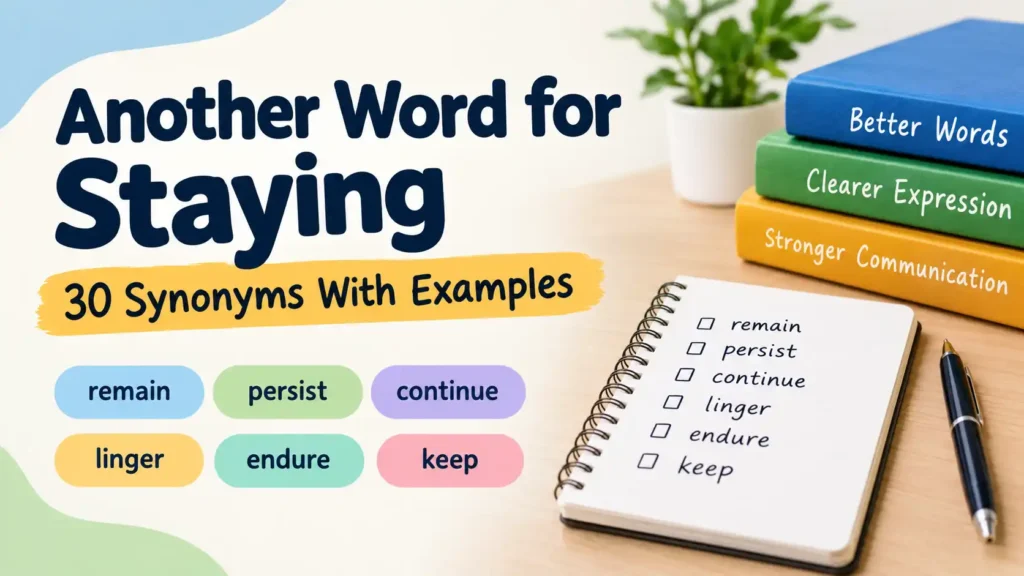
Another word for staying depends on the meaning you want to express. Common alternatives include remaining, living, lodging, waiting, and dwelling. Each word fits a different context, from staying in a place to keeping still or continuing in a state.
For example, remaining works when something continues to exist. Meanwhile, lodging refers to having a place to sleep. Other choices include residing, lingering, abiding, and persisting. The right word depends on if you mean living somewhere, not leaving, waiting, or continuing.
Quick list: Remaining, living, lodging, residing, dwelling, waiting, lingering, abiding, persisting, and continuing.
This guide explores 30 alternatives with meanings, IPA, usage notes, and examples. It also explains common word pairs, useful phrases, and the key differences between related terms.
At a Glance: Staying Synonyms and Related Alternatives
| Alternative | Part of Speech | Meaning | Register / Tone | Ideal Context |
| Remaining | Verb form | Continuing to be present | Neutral | Not leaving |
| Living | Verb form | Making a home somewhere | Neutral | Home and daily life |
| Lodging | Noun / verb form | Having temporary shelter | Neutral | Trips and short visits |
| Residing | Verb form | Having a home in a place | Formal | Official records |
| Dwelling | Verb form | Living in a place | Formal | Home and residence |
| Waiting | Verb form | Staying until something happens | Neutral | Delays and plans |
| Lingering | Verb form | Staying longer than expected | Neutral | Delays and feelings |
| Abiding | Verb form | Staying or continuing | Formal / literary | Rules and set phrases |
| Persisting | Verb form | Continuing despite trouble | Neutral | Effort and problems |
| Continuing | Verb form | Going on without stopping | Neutral | Actions and states |
Which Word Should You Use?
| If you want to… | Use | Why |
| Say someone does not leave | Remaining | It stresses continued presence. |
| Talk about making a home somewhere | Living | It sounds natural in daily speech. |
| Describe a short visit to a hotel | Lodging | It refers to temporary shelter. |
| Give someone’s official place of residence | Residing | It suits formal writing. |
| Say someone waits for an event | Waiting | It focuses on what happens next. |
| Explain that someone stays too long | Lingering | It often suggests a longer stay than expected. |
| Show that an effort does not stop | Persisting | It stresses continued effort despite trouble. |
| Say an action goes on | Continuing | It focuses on an ongoing act or state. |
Exploring the Multiple Meanings of “Staying”
The word staying comes from the verb stay. It has several meanings based on place, time, and state.
1. Remaining in a Place
- Meaning: Staying means not leaving a place.
- Explanation: Someone may stay at home or remain in a room. This sense also covers staying in one spot.
- Example: We are staying at home until the rain stops.
2. Living Somewhere Temporarily
- Meaning: Staying can mean living somewhere for a short time.
- Explanation: Guests often stay in hotels or friends’ homes. This sense also applies to short trips and visits.
- Example: My cousins are staying at a hotel near the beach.
3. Continuing in a State
- Meaning: Staying can mean keeping the same state or condition.
- Explanation: A person may stay calm or stay awake. This sense also applies to things that remain unchanged.
- Example: She is staying calm while everyone else feels worried.
4. Waiting for Something
- Meaning: Staying may involve waiting before moving or acting.
- Explanation: People may stay in line or wait for news. This sense also covers pauses before an event.
- Example: We are staying here until the bus arrives.
5. Continuing Despite Trouble
- Meaning: Staying can mean keeping at something without giving up.
- Explanation: People may stay with a task through hard times. This sense also links to lasting effort and support.
- Example: He is staying with the team through a tough season.
6. Avoiding a Place or Activity
- Meaning: Staying can mean keeping away from a place or activity.
- Explanation: People may stay away from busy roads or stay out of trouble. This sense also suggests avoiding risk or harm.
- Example: We are staying away from the park during the storm.
Analyzing 30 Staying Alternatives in Detail
Some words below are close synonyms for staying. Others fit only certain contexts, such as living somewhere or waiting for an event.
Core Synonyms for Not Leaving
1. Remaining
IPA: US /rɪˈmeɪnɪŋ/ · UK /rɪˈmeɪnɪŋ/
Definition: Remaining means continuing to be in a place or state. It also means not leaving when others go.
- Usage: This is one of the closest alternatives to staying. However, it often sounds more formal.
- Example: She is remaining at school to finish her science project.
2. Waiting
IPA: US /ˈweɪtɪŋ/ · UK /ˈweɪtɪŋ/
Definition: Waiting means staying until something happens. It also means holding off before taking action.
- Usage: This word fits when someone expects an event. However, it does not always mean staying in one place.
- Example: Dad is waiting outside until the shop opens.
3. Lingering
IPA: US /ˈlɪŋɡərɪŋ/ · UK /ˈlɪŋɡərɪŋ/
Definition: Lingering means staying longer than expected. It also means taking extra time before leaving.
- Usage: This word often suggests a slow or late departure. For example, people may linger after a meal.
- Example: We were lingering in the garden after the family lunch.
4. Tarrying
IPA: US /ˈtæriɪŋ/ · UK /ˈtæriɪŋ/
Definition: Tarrying means staying or waiting for some time. It also suggests a delay before moving on.
- Usage: This is an old-fashioned word for staying or waiting. However, it may suit stories or formal writing.
- Example: The travelers were traveling in town before their long trip.
5. Abiding
IPA: US /əˈbaɪdɪŋ/ · UK /əˈbaɪdɪŋ/
Definition: Abiding can mean staying in a place or state. It also means lasting for a long time.
- Usage: This word sounds formal or literary when it means staying. However, abiding by rules means following them.
- Example: They are abiding in the small village for the winter.
Words for Living or Visiting a Place
6. Living
IPA: US /ˈlɪvɪŋ/ · UK /ˈlɪvɪŋ/
Definition: Living means making a home in a place. It also refers to being alive or having a life there.
- Usage: This is a natural choice for daily speech. However, it may suggest a longer stay than a short visit.
- Example: My aunt is living with us while her home gets fixed.
7. Residing
IPA: US /rɪˈzaɪdɪŋ/ · UK /rɪˈzaɪdɪŋ/
Definition: Residing means having a home in a place. It also refers to where someone lives.
- Usage: This word is more formal than living. For example, it fits forms and official records.
- Example: He is residing in Lahore while he studies at college.
8. Dwelling
IPA: US /ˈdwɛlɪŋ/ · UK /ˈdwɛlɪŋ/
Definition: Dwelling means living in a place. It also refers to making one’s home there.
- Usage: This word sounds formal or literary when it means living. However, dwelling on a problem means thinking about it too much.
- Example: The family is dwelling in a cottage near the lake.
9. Lodging
IPA: US /ˈlɑdʒɪŋ/ · UK /ˈlɒdʒɪŋ/
Definition: Lodging means staying somewhere as a guest. It also refers to a place that provides a bed or room.
- Usage: This word fits short visits and trips. However, it may refer to the room or shelter rather than the act of staying.
- Example: We are lodging at a small inn beside the road.
10. Sojourning
IPA: US /ˈsoʊdʒɜrnɪŋ/ · UK /ˈsəʊdʒɜːnɪŋ/
Definition: Sojourning means staying somewhere for a short time. It also suggests a temporary visit away from home.
- Usage: This is a formal or literary choice. For everyday speech, staying or visiting sounds more natural.
- Example: She is sojourning in Rome during her summer break.
Words for Pausing or Spending Time
11. Pausing
IPA: US /ˈpɔzɪŋ/ · UK /ˈpɔːzɪŋ/
Definition: Pausing means stopping for a short time. It also means taking a brief break before carrying on.
- Usage: This word fits a short stop in an action. However, it does not always mean remaining in a place.
- Example: He is pausing at the gate to check his phone.
12. Halting
IPA: US /ˈhɔltɪŋ/ · UK /ˈhɔːltɪŋ/
Definition: Halting means stopping movement or action. It also refers to bringing progress to a stop.
- Usage: This word stresses a stop rather than a long stay. For example, a person may halt before crossing a road.
- Example: The driver is halting near the gate to let us out.
13. Stopping
IPA: US /ˈstɑpɪŋ/ · UK /ˈstɒpɪŋ/
Definition: Stopping means ending movement or action for a time. It also means making a short visit along the way.
- Usage: This is a common word for a brief pause. However, stopping at a hotel can mean staying there overnight.
- Example: We are stopping at a cafe before driving home.
14. Visiting
IPA: US /ˈvɪzɪtɪŋ/ · UK /ˈvɪzɪtɪŋ/
Definition: Visiting means going to see a person or place. It also refers to spending time there as a guest.
- Usage: This is a related alternative when staying involves a visit. However, visiting does not always mean sleeping there.
- Example: We are visiting our grandparents for the whole weekend.
15. Soaking
IPA: US /ˈsoʊkɪŋ/ · UK /ˈsəʊkɪŋ/
Definition: Soaking means making something very wet or letting it sit in liquid. It also refers to being wet through.
- Usage: This is not a direct synonym for staying. It fits only in phrases such as soaking in a bath.
- Example: He is soaking in the tub after a long day.
Words for Staying in a State
16. Continuing
IPA: US /kənˈtɪnjuɪŋ/ · UK /kənˈtɪnjuːɪŋ/
Definition: Continuing means carrying on without ending. It also means keeping an action or state going.
- Usage: This word fits staying with an action or condition. However, it does not always mean staying in one place.
- Example: She is continuing her work while the rest of us take a break.
17. Persisting
IPA: US /pərˈsɪstɪŋ/ · UK /pəˈsɪstɪŋ/
Definition: Persisting means continuing despite trouble or delay. It also means refusing to give up on a task.
- Usage: This word stresses effort over time. For example, a person may persist with a hard task.
- Example: He is persisting with his studies despite the busy week.
18. Enduring
IPA: US /ɪnˈdʊrɪŋ/ · UK /ɪnˈdjʊərɪŋ/
Definition: Enduring means lasting through time or hardship. It also means bearing a hard event without giving up.
- Usage: This word fits long periods or tough times. However, it does not simply mean staying in a room.
- Example: They are enduring a long wait at the airport.
19. Lasting
IPA: US /ˈlæstɪŋ/ · UK /ˈlɑːstɪŋ/
Definition: Lasting means continuing for a long time. It also means not ending or fading quickly.
- Usage: This word often describes effects, ties, or states. However, it is not a direct substitute for every use of staying.
- Example: Their friendship is lasting through many changes in life.
20. Keeping
IPA: US /ˈkiːpɪŋ/ · UK /ˈkiːpɪŋ/
Definition: Keeping can mean holding or maintaining something. It also means remaining in a state in phrases like keeping calm.
- Usage: This word fits set phrases about a state or condition. However, it does not replace staying in every context.
- Example: She is keeping quiet while the baby sleeps.
Words for Staying Close or in Place
21. Hanging Around
IPA: US /ˌhæŋɪŋ əˈraʊnd/ · UK /ˌhæŋɪŋ əˈraʊnd/
Definition: Hanging around means spending time in a place without a clear task. It also means staying nearby while waiting.
- Usage: This phrase is informal and common in speech. However, it may suggest that someone has little to do.
- Example: The kids are hanging around outside until practice starts.
22. Lingering On
IPA: US /ˈlɪŋɡərɪŋ ɑn/ · UK /ˈlɪŋɡərɪŋ ɒn/
Definition: Lingering on means continuing longer than expected. It also refers to a feeling or effect that lasts.
- Usage: This phrase fits both time and lasting effects. For example, a smell may linger on after cooking.
- Example: The smell of fresh bread is lingering on in the kitchen.
23. Hovering
IPA: US /ˈhʌvərɪŋ/ · UK /ˈhɒvərɪŋ/
Definition: Hovering means staying close to a person or place. It also means remaining near without settling fully.
- Usage: This word suggests close presence or little movement. However, it can sound critical when someone watches another person too closely.
- Example: Dad is hovering near the door while we pack.
24. Loitering
IPA: US /ˈlɔɪtərɪŋ/ · UK /ˈlɔɪtərɪŋ/
Definition: Loitering means staying in a place without a clear reason. It also suggests spending time there longer than needed.
- Usage: This word can sound disapproving. For example, signs may warn people against loitering near an entrance.
- Example: The group was loitering outside the shop after closing time.
25. Staying Put
IPA: US /ˌsteɪɪŋ ˈpʊt/ · UK /ˌsteɪɪŋ ˈpʊt/
Definition: Staying put means not moving from a place. It also means keeping things as they are.
- Usage: This is an everyday phrase for not leaving. However, it can also suggest refusing to move or change.
- Example: We are staying put until the storm passes.
Words for Keeping a Place or Role
26. Holding On
IPA: US /ˌhoʊldɪŋ ˈɑn/ · UK /ˌhəʊldɪŋ ˈɒn/
Definition: Holding on means keeping a grip or not giving up. It also refers to waiting for a short time.
- Usage: This phrase fits effort, hope, or a phone call. However, it is not a direct synonym for staying in a place.
- Example: Please hold on while I find your order.
27. Sticking Around
IPA: US /ˌstɪkɪŋ əˈraʊnd/ · UK /ˌstɪkɪŋ əˈraʊnd/
Definition: Sticking around means staying in a place for some time. It also suggests remaining nearby instead of leaving.
- Usage: This phrase is informal and friendly. For example, people may stick around after a show to chat.
- Example: We are sticking around after class to ask a few questions.
28. Staying On
IPA: US /ˌsteɪɪŋ ˈɑn/ · UK /ˌsteɪɪŋ ˈɒn/
Definition: Staying on means remaining after others leave or after a set time. It also means continuing in a job or role.
- Usage: This phrase fits work, school, and longer visits. However, the exact meaning depends on the words around it.
- Example: She is staying on at work to finish the report.
29. Holding Steady
IPA: US /ˌhoʊldɪŋ ˈstɛdi/ · UK /ˌhəʊldɪŋ ˈstɛdi/
Definition: Holding steady means keeping the same level or state. It also means not changing much under pressure.
- Usage: This phrase is related to staying in a condition. However, it often refers to levels, progress, or emotions.
- Example: Sales are holding steady despite the quiet month.
30. Persevering
IPA: US /ˌpɜrsəˈvɪrɪŋ/ · UK /ˌpɜːsɪˈvɪərɪŋ/
Definition: Persevering means continuing despite hard work or setbacks. It also means keeping at a goal until progress comes.
- Usage: This word relates to staying with a task, not staying in a place. It sounds more formal than sticking with it.
- Example: He is persevering with his reading practice each evening.
Staying vs. Remaining vs. Residing
These three words can relate to being in a place. However, they differ in length of time and tone.
| Word | Main Meaning | Best Context | Example |
| Staying | Not leaving or living somewhere temporarily | Visits and daily speech | We are staying with friends. |
| Remaining | Continuing to be present | General use and formal writing | She is remaining at school. |
| Residing | Having a home in a place | Official or formal use | He is residing in Lahore. |
| Lodging | Staying somewhere as a guest | Trips and short visits | They are lodging at an inn. |
| Lingering | Staying longer than expected | Delays or slow departures | We are lingering after dinner. |
How to choose: Use staying for general use. Choose remaining when you want to stress not leaving. Use residing for someone’s home address or place of residence. Meanwhile, lodging points to a temporary place to sleep.
Staying and Opposite/Paired Word Pairs
| Word | Paired Word | Note |
| Staying | Leaving | Remaining in a place versus going away |
| Staying | Departing | Continuing to be present versus setting off |
| Staying | Arriving | Being present versus reaching a place |
| Staying | Moving | Remaining in place versus changing position |
| Staying | Returning | Continuing a visit versus coming back |
| Staying | Visiting | Remaining somewhere versus going to see someone |
| Staying | Waiting | Remaining until an event versus expecting it to happen |
| Staying | Going | Continuing to be present versus moving away |
These pairs do not all form exact opposites. For example, arriving marks the start of a visit, while staying refers to remaining there. Likewise, waiting can happen while someone is staying in one place.
Common Word Partners of “Staying”
The words that follow staying help show its meaning. These common patterns cover places, states, time, and actions.
| Pattern | Common Partners | Example |
| Staying + place | at home, indoors, outside | We are staying indoors today. |
| Staying + accommodation | at a hotel, with friends | She is staying with friends. |
| Staying + state | calm, healthy, awake | He is staying awake to study. |
| Staying + duration | overnight, for a week | They are staying overnight. |
| Staying + time link | until Monday, all day | We are staying until Monday. |
| Staying + distance | nearby, close, together | The children are staying close. |
| Staying + avoidance | away from trouble, out of danger | He is staying away from trouble. |
| Staying + role | on the team, in the job | She is staying on the team. |
| Staying + effort | with the task, focused | I am staying focused on my work. |
| Staying + location | in town, at school | We are staying in town. |
Idiomatic Phrases Featuring “Staying”
Some phrases with staying have set meanings. Others are common expressions rather than true idioms.
1. Staying Put
- Meaning: Remaining in the same place without moving away.
- Example: We are staying put until the roads are safe.
2. Staying the Course
- Meaning: Continuing with a plan despite trouble or delay.
- Example: She is staying the course and working toward her goal.
3. Staying Up
- Meaning: Remaining awake instead of going to bed.
- Example: I am staying up late to finish my book.
4. Staying Away
- Meaning: Keeping away from a person, place, or thing.
- Example: He is staying away from the busy road today.
These phrases suit different needs. Staying put focuses on place, while staying the course focuses on effort. Meanwhile, staying up refers to sleep, and staying away means avoiding contact or distance.
Word Formation of “Staying”
Etymology and Structure
Staying is the present participle of the verb stay. It combines the base word stay with the ending -ing. The ending can show an action in progress, as in staying at home.
The verb stay came into English through Anglo-French and Old French. Its roots trace back to the Latin word stare, meaning to stand. Over time, stay gained the sense of remaining in a place.
Date and History
The verb stay appears in Middle English records from around the 15th century. The sense of remaining rather than leaving dates to the late 16th century. The sense of staying as a temporary guest dates to the 16th century.
Word Class Variations
| Word Form | Part of Speech | Meaning | Example |
| Stay | Verb | Remain in a place or state | Please stay here. |
| Staying | Present participle | Remaining or continuing | We are staying overnight. |
| Stayed | Past tense / past participle | Remained or continued | They stayed for dinner. |
| Stays | Third-person verb form | Remains or continues | He stays with his aunt. |
| Stay | Noun | A period spent in a place | Our stay lasted three days. |
| Staying power | Noun phrase | The ability to last | This team has staying power. |
Common Word-Choice Mistakes
These corrections help you choose the right word for each meaning.
- Wrong: I am residing at the hotel for one night. Better: I am staying at the hotel for one night.
- Wrong: We are staying on the bus until it arrives. Better: We are waiting for the bus to arrive.
- Wrong: She is lingering at home for a year. Better: She is living at home for a year.
- Wrong: He is following the rules. Better: He is abiding by the rules.
- Wrong: They are lodging with the park. Better: They are staying near the park.
- Wrong: I am staying at my work. Better: I am continuing my work.
- Wrong: She is staying in the hotel. Better: She is remaining at the hotel.
Frequently Asked Questions
1. What is the closest synonym for staying?
Remaining is one of the closest synonyms when staying means not leaving. However, living or lodging may fit better for a visit.
2. What is another word for staying in a place?
Use remaining when someone does not leave. You can also use staying put for an informal tone.
3. What is a formal word for staying?
Residing is a formal choice when talking about someone’s home. Meanwhile, remaining fits formal writing about continued presence.
4. What is another word for staying overnight?
Use lodging when referring to temporary accommodation. You can also say spending the night in everyday English.
5. What is a literary word for staying?
Tarrying and sojourning can fit literary writing. However, both sound less common in everyday speech.
6. What is the difference between staying and remaining?
Staying often refers to a visit or continued presence. Remaining stresses not leaving or continuing to be present.
7. What is the difference between staying and residing?
Staying often suggests a temporary visit. Residing usually refers to having a home in a place.
8. What is the opposite of staying?
Leaving is the most common opposite when staying means not going away. Other choices include departing and moving on.
9. Can staying mean continuing?
Yes. Staying calm means continuing to be calm, while staying awake means not falling asleep.
10. Is staying the same as waiting?
Not always. Staying means remaining in a place or state, while waiting means expecting something to happen.
Conclusion
The best alternatives to staying include remaining, living, lodging, residing, and waiting. Each word fits a different meaning, so choose one that matches your sentence.
For a temporary visit, use staying or lodging. When someone does not leave, remaining works well. Meanwhile, residing suits formal writing about a home.
Always check the context before choosing a synonym. The right word will make your meaning clear and help your writing sound natural.

Sikandar Hayat is the author of PublivoHub.com, a platform dedicated to synonyms, alternative words, and vocabulary improvement. He aims to help readers find the right words and express their ideas more clearly and effectively. Through simple explanations and useful word alternatives, Sikandar makes it easier for students, writers, bloggers, and everyday readers to improve their writing and expand their vocabulary.